


Showing posts with label salads. Show all posts

Monday, March 05, 2007

Cajun Salmon & Herb Marinated Calamari


*Just Braise has moved. Please visit me at www.justbraise.com!*

It is often that when I buy seafood I tend to go a little crazy. The briny smell, the lobsters swimming around, the gracious smiles and even the slight attitude I get when I ask something possibly(?) silly like, “what does that taste like?” Response: “White fish.” Or: “How do I cook this?” Response: “However you like.” Or my recent favorite, “I’m cooking this with capers, do you have capers?” Response: “I don’t even know what that is lady.” It all makes for that authenticity that screams burly fisherman and has me coming back for more than I really need.

Okay, so my local fishmonger spends little to no time on a boat actually fishing. More of it is spent “fishing” up in the Bronx at the newly relocated Fulton Fish Market. Still, entering the place is like hanging out with the boys on the docks—on a recent visit I overheard a few stories about the original Woodstock and how the “experience” was “a total trip.” I can guess a few enhancers that would lead to “trippy experiences” that my friendly fisherman might have partaken in. Instead, I kindly smiled and asked for a pound of calamari, cleaned, yes, thank you. And a pound of salmon too please.

While the two in combination are not totally exotic, they started to sound really good when I put words like “cajun blackening” and “Thai herb marinated” in front of them, albeit spicey. It also helps to have a winning cookbook (that’s right, The Cook’s Book, where every recipe is clearly laid out with fabulous photography and claims both these recipes as a cinch to make (which is true).

With a helper tuned to the task at hand, this meal can be whipped up in about 30 minutes, less if you are really on cue. The procession:

Person 1: Prep/ marinate salmon, prep/ marinate calamari.
Person 2: Prepare salad
Together: Prepare fish. The calamari takes a mere 3 minutes to cook and the salmon 6. If you start the salmon, get the calamari going, flip the salmon, remove calamari, the salmon is just about done, all remains hot to serve and you’re good to go.

Throw in a new favorite quick salad (our own invention) this meal is golden-- or better yet, a deliciously trippy experience.

The salmon and calamari recipe are as they appear in The Cook’s Book. When I made this I bought 1 pound of calamari and almost 1 pound of salmon and cut the salmon into 4 fillets. This meal was a satisfying dinner and an even better lunch the next day. It will definitely be made again. The salmon looks daunting, but many of the spices are staples (or should be) or could possibly be left out.

SALMON WITH CAJUN BLACKENING SPICES
Serving Size= 4. Active time= about 20 minutes. Cook time= about 8 minutes.
* 1 tablespoon ground cumin
* 1 tablespoon coriander seeds, crushed
* 1 tablespoon dried ground garlic
* 2 tablespoons paprika or pimento (smoked Spanish paprika)
* 1 tablespoon coarsely ground white or black pepper
* 1 tablespoon dried thyme
* 1 teaspoon dried oregano
* 2 tablespoons fine salt
* 4 salmon fillets, about 6 oz each (skinned)
* vegetable oil

1) Mix together all spices, herbs and salt. Using half the mixture [per side], rub into both sides of the pieces of salmon and lay them on a tray. Cover and leave at room temperature for up to 30 minutes.
2) Heat a heavy-based frying pan over high heat until very hot. Brush the pan with oil, then place the fillets in the pan. Let cook for 2 minutes without moving them. Turn the fish over, cover the pan, and cook for 2 more minutes. The spices will have blackened and the fish will be barely cooked inside. Transfer the salmon to warm plates and serve. [We cooked ours 3 minutes each side and they came out perfect, cooked almost all the way through.]


THAI BASIL & CILANTRO MARINATED SQUID
Serving Size= 4. Active time= about 8 minutes. Cook time= about 2 minutes.
* 1-½ heaped teaspoons white peppercorns [use about half if you only have black or mixed]
* ½ teaspoon salt
* 1 garlic clove
* handful of Thai basil [regular tastes good too]
* handful of cilantro, including roots, steams and leaves
* 14 oz squid, cleaned, then body finely sliced into rings and tentacles separated
* 2 teaspoons peanut oil
* 1 teaspoon nam pla (fish sauce)
* 2 teaspoons finely chopped or grated pale palm sugar [I omitted this ingredient]

1) Lightly pound the peppercorns, salt and garlic in a mortar with a pestle until combined. Add the basil and cilantro, and work into a chunky paste [alternately a food processor can be used]. Put the quid into a bowl and coat with the paste. Leave at room temperature for 15 minutes.
2) Heat a wok until smoking. Add half the oil and swirl it around. Add half the squid and cook over high heat for 30 seconds, tossing it a little. Tip the squid into a bowl. Wipe the wok clean, then cook the remaining squid in the same way.
3) Return the first batch of squid to the wok and add the fish sauce and palm sugar. Toss together and cook for 20 seconds longer.


OUR NEW FAVORITE WINTER SALAD
Serving Size= 4. Active time= about 8 minutes.
* ½ small red cabbage, thinly sliced (alternatively, a fennel bulb is delicious)
* 1 orange, peeled and cut into 1 inch pieces
* 1 grapefruit, peeled and cut into 1 inch pieces
* juice of ½ a lemon
* 2 tablespoons cider vinegar (or champagne vinegar)
* ¼ cup parmesan cheese, grated
* 1 teaspoon anise seeds (if using fennel bulb omit this)
* salt/ pepper to taste

1) Slice the vegetable and fruit. Put everything into a bowl, toss and serve.

Saturday, January 13, 2007

Sunchoke (Jerusalem Artichoke) Salad


Last year, I read so much about the little Sunchoke that I grew overwhelmed with joy when they finally appeared at the market. I bought a bunch and made some hearty soup that whisked away cold days. The sunchoke is hearty, sweet and not only tastes great raw, but is a great substitute for the potato.

Over the holidays I was around San Francisco visiting family. My uncle is taking a Master Gardening class and over the years built a substantial garden on his property. It is one that I am extremely jealous of and if he happened to have an avocado tree I would seriously consider moving in. Still, it does include blueberry and raspberry bushes, plum trees and strawberries all for my grandmother to make jams from (nothing but fruit and sugar, not even water she'll proudly tell you multiple times), tons of nasturtium flowers (that my uncle says proliferate like weeds), herbs of all kinds, artichokes, sunflowers, grape vines, tomatoes, a massive worm farm for compost, roses, a myer lemon tree and sunchokes.

He showed me around his garden saying most of what he has is just for play: he plants things and watches how they grow, rarely harvesting anything. One morning, I nabbed one of the last non-flowered artichokes for myself and boiled it up. I don't think there is anything more tasty and satisfying than eating something straight from a garden. He showed me the sunchoke bin, telling me they grew so robustly that the bin almost burst. He dug some up to show me there was literally wall-to-wall sunchokes growing underneath the dirt.

The next day while sauerkraut and ham was being served, I ran out to the garden and grabbed a handful of sunchokes and clipped some lavender leaves. I sliced the sunchokes thin and sauteed them until crisp with lots of butter, garlic and the lavender. My grandmother and mother were both pleasantly surprised at this previous unknown vegetable and refused to share them with anyone. I was pleasantly surprised at the mild taste of the lavender with the sunchokes.

My uncle gave me a bag of sunchokes to take home and plant in my own (pathetic in comparison) bucket garden. They are perfect because from the outset they appear to be weeds-- perfect in a city where old ladies steel my tomatoes and chicken wire. They are safely hibernating and will hopefully produce well come harvest next fall.

In the meantime, it's difficult to let a bag of fresh organic sunchokes go untouched. I made this salad for dinner the other day and D surprisingly applauded it (when I initially told him the ingredients he said the salad sounded like "weird girly veggie mush"). I'm not totally sure I know what that classifies as (I think zucchini is on the "veggie mush" list though), but once he ate this he assured me he would eat it again-- especially the sunchokes!

This is a visually stunning winter salad. It is hearty and really shows off that winter food can be just as beautiful as summer food. It also has fabulous texture layers and an interesting array of flavors. If you are dexterous you can cut down on cook time by sauteing the mushroom at the same time as frying the sunchok (since the sunchokes only take about 2 minutes in the oil).

Sunchoke Salad
Serves 2. Active time= about 30 minutes.
* 1 cup green beans, cut into 1 inch spears
*1 head endive, sliced thin
* 1 yellow pepper, left whole
* 1 portabello mushroom, sliced into 1/2 inch shoots
* 1 cup vegetable oil (more or less depending on pan)
* 1 sunchoke, well scrubbed and sliced into 1/8 inch rounds
* 1 tablespoon goat cheese
* 4-6 grape tomatoes

1) On the serving plate/ bowl, arrange green beans and endive.
2) Prep: Set a paper bag in a bowl aside. Set paper towels on a plate aside.
3) Roast the yellow pepper: Using long metal tongs, set pepper over burner set on medium-high flame. Rotate the pepper until all sides are blackened, about 6 minutes total (this only works with gas stoves as an open flame is needed. Another option is to dry roast the pepper on a non-stick pan until blackened). Place the pepper into the paper bag and seal. Set aside. This completes the pepper's cooking.
4) In a small pan on medium heat, saute the portabello mushroom. While the mushroom is cooking, put the vegetable oil in a medium sauce pan on high heat. While oil is warming, finish the mushrooms, cooking until reduced and darkened, about 8 minutes. Arrange the mushrooms on the serving plate.
5) When the oil is hot, fry the sunchokes quickly, removing when they turn brown around the edges. About 2-3 minutes total should turn them crisp. Remove from oil, place on the napkin covered plate and sprinkle lightly with salt.
6) Remove the yellow (now blackened) pepper from the paper bag. The skin will begin to flake off. For fast removal, place whole pepper under lukewarm water, gently rubbing ashes from the pepper. Dry off and slice into 1/2 inch spears, add to serving plate.
7) Sprinkle grape tomatoes over salad arrangement. Add goat cheese in a single lump. Spear sunchokes into the goat cheese to allow the sunchoke chips to stand verticle. Top salad with olive oil, a light sprinkle of salt and a spritz of lemon (optional). Any more dressing would ruin the flavors in this salad.

Sunday, August 20, 2006

Rainbow Salad


*Just Braise has moved. Please visit me at www.justbraise.com!*

As the nights begin to cool and we turn the first corner into the fall season, it is best to take advantage of the freshness still available. Late season produce are some of my favorites; full of the warm juices of summer. They include certain berries, corn, peaches, beets and nectarines (amongst others). Keep to the seasons and you are guaranteed some of the best tasting produce.

When I started going hog wild for the peaches at my local fruit stand, D and I were overwhelmed (but they smell so good!)—there are only so many that can be sliced and frozen for mid-winter smoothie binges! Pretty soon, every time I made a dish, I just tossed a few peaches onto the mix. D thought me crazed at first, tainting his otherwise prized pork and sandwiches, but pretty soon, the boy caught on.

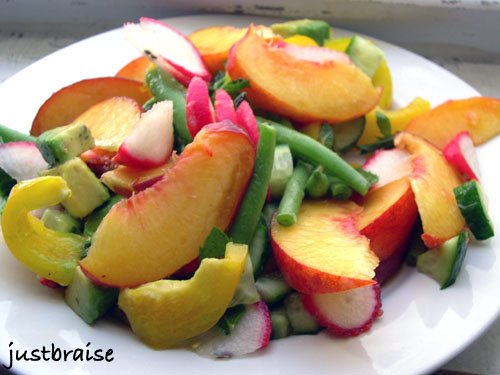
One morning as we were rushing out the door I pulled out anything and everything fresh from the fridge. It ended with a very colorful salad that appeared to taste as good as it looked. A few hours later I received emails from D that his officemates wouldn’t allow him to get a bite in—they were all admiring the colors! While we ate separately, we came together later commenting on the perfect harmony that the salad offered. No longer questioning my peach plundering, D and I made this salad again and again—a fast and fresh summer pick-me-up that can be altered in many ways, remaining a delicious feast for belly and eyes.

The colors on this salad are stunning--- an ideal side for a summer picnic or BBQ. So go ahead and stock up on peaches. Put a few aside for the winter, and indulge in this salad while peaches are at their best.

RAINBOW SALAD w/ BASIL VINAIGRETTE
Serving Size= 2 persons. Active time= 10 minutes.
* 2 ripe peaches, each sliced into 8 wedges
* 4 radish, sliced
* 1 avocado, cubed
* 1 yellow bell pepper, sliced thin
* 1 small cucumber, cubed
* 1 small handful green beans, blanched and halved
* 1 cup lightly packed fresh basil
* ¼ cup Tarragon vinegar
* juice of 1 lime
* salt/ pepper to taste

1) In a medium bowl, gently toss cut fruit and vegetables: peach, radish, avocado, bell pepper and beans.
2) In a food processor or blender, combine basil, vinegar and lime juice. Blend until basil is finely chopped and well incorporated. Season to taste with salt and pepper and pour over salad.
NOTE: Other tasty additions to this salad include celery, mango (in lieu of peach), corn, new potatoes, or anything else you enjoy.

Wednesday, August 16, 2006

Lebanese Potatoes


I was never too fond of potato salad growing up; the same goes for coleslaw and most macaroni salads. Often heavy with mayonnaise, I felt true flavors were hidden under a thick suffocating whiteness. I grew tired of finding a good, let alone perfect, potato salad, and my life of avoiding the tot began.

People accused me of being anti-carbohydrate. It simply is not so! I would proclaim. I love baked potatoes, bread, and most every carbohydrate there is. Then there was a jab that I was a food snob. Okay, maybe a bit. But it is when the wet white blanket covers my pure fare that I cringe and must walk away, head bowed low in a quiet, mournful state—that pastiness just sticks to my mouth too readily.

Being a frequenter of BBQs and returns to the Midwest does not help matters. Some sort of mayonnaise-based salad is always happy to make an appearance. It is not that I cannot give new foods a try, but I follow a mantra that the lesser the mayo the better.

One day, my good friend A showed me the light.

I sat at her aunt’s home for a wholesome Lebanese-American Thanksgiving. It was complete with hummus, flat bread, ful, turkey and a bowl of Lebanese potatoes. For once, I saw a potato salad where, surprise upon surprises, the potato shown through. One bite, and I pocketed this recipe with delight.

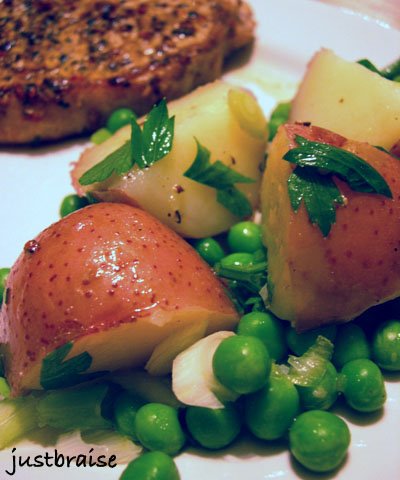
It is the lightness of the salad and ease of preparation that draws me back to this dish again and again. I have made it for others with the same promising accolades; it is simple and delicious. Below I have spruced it up by adding green peas. The brightness of these peas gave the red potatoes a sensational contrast. For those who are have fought off one too many mayonnaise dripping salads, now is your chance to bring the potato back to flavor.

LEBANESE POTATOES
Serving Size= 6-8 persons. Active time= 10 minutes. Inactive time= 2 hours.
* 8-10 small red new potatoes, washed and cut in half
* 1 bunch parsley, washed and chopped
* juice of 1-½ lemons
* 1 cup peas, lightly cooked (optional; not traditional, but good)
* 1 bunch scallions, chopped whites only
* 2 cloves garlic, crushed
* 4 Tbl olive oil
* salt/ pepper to taste

1) In a medium saucepan, bring 4 cups of salted water to a boil. Add potatoes and cook until tender, about 20 minutes. Run cold water over to stop cooking and begin cool down.
2) In a medium sauté pan, flash-cook the peas with a small amount of water, about 4 minutes until peas turn dark green.
3) Place all ingredients into a large bowl. Mix well and refrigerate until cool, about 1-½ hours.

Wednesday, April 19, 2006

Scallop Salad


More beets and another salad… Can a girl get tired of such sweet treats?

While the sun decides to let me linger on the streets a little longer, it becomes more difficult after a day at work to take refuge to the kitchen. However, I have beets (the last of them) that need some quick vanishing (as well as a light purse to care for).

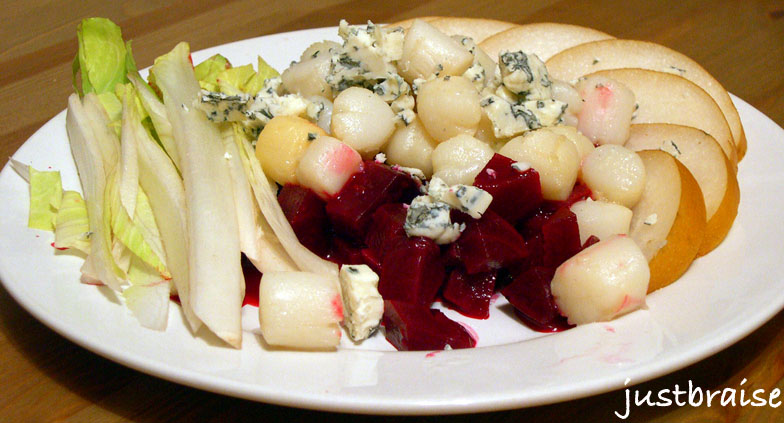
Light, sweet and buttery, I decided scallops were an unusual yet natural pairing with the beets. Accompanied with some classic, subtle salad ingredients, this meal is a winner for a quick and painless feast on a warm day.

Asian Pear is given space on this plate. A cross between a crisp, juicy apple and an almost ripe pear, this fruit provides a splash of exotica to the salad. There is a woman I work with who can go on at length about the perfect fruit. She is from the Philippines and wins the fruit battles that ensue when we talk, mentioning it always taste better at home, in the Philippines. I believe this is true for anyone, wherever they may be from: an American will swear their apples are the best only back home, an Egyptian proclaims their dates to be the sweetest only when seated by the Red Sea, and a Haitian will only eat mangoes when on their own shores.

So when I brought an Asian Pear into the office I was sure she would brush me off with another one of her, “oh, back home ours are much tastier. You have not lived…” Sure enough, she saw my pear: “Oh those pears, they grow all over in my country…” Finishing with “it is the only fruit I do not like.” I paused, unable to comprehend how someone could not love a combination of the two greatest fruits: “I prefer your American pears much better. So much sweeter.” And with that, she shrugged her shoulders and walked away. For those who agree, or do not have Asian Pear handy, a regular pear or crisp apple may be substituted in this meal.

I have discussed previously how to pick scallops, here offering an alternate cooking method. They may be chilled before being placed on the salad, or served warm scattered over top. Nuts may also be added to this salad for another crunch.

SCALLOP SALAD
Makes: 2 servings. Active Time= 10 minutes. Cook Time= 45 minutes (if beets are not already prepared).
* 1 medium beet
* ½ pound Bay Scallops
* 1 Asian Pear (apple or pear is suitable too), sliced thin
* 1 endive head, sliced this
* 2 Tbl blue cheese
* 1 Tbl butter
* 1 Tbl spicy mustard
* 1 Tbl vinegar (tarragon or wine)
* 1 Tbl fresh lemon juice

1) Braise or boil beets according to directions from previous two posts. Slice and place on plate.
2) Warm a pan over medium heat with the butter. Wash the scallops under water. Once pan is warm and butter melted, sauté the scallops about 8 minutes until lightly golden. While cooking, prepare the remaining salad.
3) Arrange sliced Asian Pear and endive on plate. Toss scallops on top, add crumbled blue cheese over whole.
4) In a small bowl mix mustard, vinegar and lemon juice. Pour over salad just before serving.

Tuesday, April 18, 2006

Beet & Bean Salad


It seems there are those who are not as gastronomically in-tune with beets as myself. How did this blushing beauty get such a bad rap? Full of color, sweet, delicious and combining well with almost anything-- where did the sweet beet go wrong in history? Is it that slightly off-putting exterior? I know many other vegetables that look much worse off (dinosaur kale, parsnips, dare I say celery root and sunchokes?!). Is it too economical? Eating both leaves and root of a single vegetable is too smart for the purse strings? Is it my Eastern European heritage that has me craving the rubies of the Earth?

Here’s to beets, the sweetest of all vegetables (while remaining low in calories) and all their nutritional goodness.

Notes on this salad: I used beets leftover from myBraised Beets, hence the minimal cook time noted below. If making fresh beets, you can braise them or boil them for 45 minutes; until soft. Because these beets were braised in orange juice, they had an extra citrus sweet tang that allowed this salad to pair nicely with an orange juice-lemon vinaigrette. I think this salad would have been delicious (and beautiful) with some sliced oranges added on top.

BEET & BEAN SALAD
Makes: 2 servings. Active Time= 10 minutes. Cook Time= 45 minutes.
* 2 medium-sized beets
* 10-15 green beans
* Parmesan cheese to taste
* 1 Tbl orange juice
* 1 Tbl lemon juice
* 1 Tbl vinegar (tarragon or wine)

1) Bring a pot with about 4 cups of water (enough to cover the beets) to a boil on the stovetop. Cut stems off beets leaving about 1 inch of stem in tact. Wash thoroughly and place in boiling water for 45 minutes; until soft.
2) Remove beets from water and place in ice bath (you can retain and freeze beet juice from the boiling pot and use it for soup another time). Remove skins, they should fall off with slight nudge. Slice beets in ¼ inch cubes or discs.
3) Wash and blanch green beans (with a little water in a hot saucepan heat beans 2-3 minutes until they turn dark). Add on top of beets.
4) Sprinkle with Parmesan
5) Combine orange juice, lemon juice and vinegar in a small bowl. Drizzle over top when ready to serve.
Note: Sliced oranges would go nicely on this salad.


Head on over to Sweetnick's for today's ARF roundup!

Tuesday, April 04, 2006

Roast Lamb w/ Mango-Mint Sauce, Moroccan Millet & Rum Pineapple w/ Baby Almonds


Spring is a fabulous time to slow down a little before the summer hustle. It is the time when we come out of doors with welcome arms. Everyone seems happier, more active and generally more excited to be alive. With this in mind, it is also a great time to celebrate. Be it any occasion: holiday, birthday, the weather itself, friends or engagements, now is the time to invite your loved ones into your home.

It was the combination of a traveling actor friend in town and two recent engagements of marriage that my friends would dine with me tonight. Their task was simple: a few bottles of wine. My task was to prepare an ideal spring feast. I believe we all accomplished our set duties.

While mulling over menu options I was torn between chicken, pork or lamb. Chicken seemed too average and easy, pork was, you know, the other white meat. Lamb seemed exotic. But while many people take great fear of lamb, I figured my friends were the adventurous types and I would forge ahead.

Sure enough when we sat to the table my friend DR voiced his concern: “You know Stacey, I’ve never eaten good lamb. I’m kind of afraid. It’s all been slightly… barnyardy?”

“That’s okay,” I reassured him, “I’ve never cooked lamb before, so we’re kind of even.” With that, he finished off his glass of wine. DR’s fiancé then voiced her concerns, “I’ve eaten lamb in kibe (Middle Eastern lamb balls with other spices) and on kebabs, but any roasted lamb I’ve ever had has been terrible.”

“Well, I’m glad you’re in for an adventure.” I returned.

No sooner was the lamb brought to the table that forks were rearing to stab at it. Across the board the meal was a success. DR and his fiancé were reassured the merits of good lamb, and I was reassured that I can cook lamb. The spices were a great compliment to the sauce, and with the millet side, everything was the colorful festive spring feast I sought.

DR mentioned his barnyardy objection to lamb. I would have to agree that lamb, like any meat is easily spoiled if a few rules are not met: freshness and cooking time. Freshness is key. If kept in the refrigerator (or meat department of your grocery store) too long the meat will begin to spoil (obviously). In the refrigerator, it will pick up the odors of food around it. Make sure to check dates and grade of meat to ensure freshness. Overcooked meat is depressing. This is easily done if a good meat thermometer is not utilized, or placed incorrectly. It is important to know what cut of meat you have, how it’s best to prepare that cut, and the ideal temperature for the outcome you desire.

With that, a fabulous spring meal, perfect for the upcoming holidays…

ROAST LAMB w/ MANGO-MINT SAUCE
Makes: 6 servings. Active Time= 30 minutes. Inactive time= 5 hours to 2 days. Cook Time= depends on size of meat; about 40 minutes.
ROAST LAMB
* 6 pound leg of lamb, ask your butcher to crack the bone and butterfly the cut**
* 3 Tbl fresh rosemary, chopped
* 3 Tbl fresh mint, chopped
* 3 Tbl fresh sage, chopped
* 2 head of garlic, 1 crushed, 1 whole
* 20 pearl onions, 10 crushed, 10 whole
* 1 Tbl ground cumin
* 1 Tbl ground cardamom
* ½ Tbl ground cinnamon
* salt/ pepper
* 4 Tbl olive oil

1) Bring the meat to room temperature before cooking. Mix the first 3 ingredients, 1 head of garlic and the ten crushed pearl onions with fresh ground pepper. Rub 2 Tbl olive oil over the lamb and rub the herb mixture over the leg of lamb; between the cuts, top and bottom. Wrap tightly in plastic wrap and refrigerate 5 hours up to 2 days.
2) Preheat the oven to 300F. Remove the lamb from the refrigerator, brushing off about half the rub. Sprinkle with cumin, cardamom, and cinnamon. Amply salt and pepper both sides and between the cuts. Tie securely with twin to hold the meat together.
3) On the stovetop in a large skillet on high heat, warm 2 Tbl olive oil. Sear the leg on all sides. Apply a fresh sprig of mint and rosemary under the twine. Chop the top off the second head of garlic, just to expose the tips and place it on the skillet. Add the onions around the lamb.
4) Place on rack, fatty side up. Insert a meat thermometer deeply, almost to the bone.
5) The meat is done when the thermometer reads 125 for medium-rare.
6) Remove from oven and allow meat to rest on cutting board for 15 minutes before slicing.


** To butterfly meat is to slice it so the meat looks like a book with the bone as the book spine.

MANGO-MINT SAUCE
* 1 fresh mango, peeled and pit discarded
* 1 cup fresh mint
* 1 tsp Serrano pepper seeds
* 1 Tbl lemon juice
* pinch of salt

1) Use a hand-held or electric blender to purée all ingredients until evenly blended. Serve at room temperature to slightly chilled.


MOROCCAN MILLET
Makes: 6 servings. Active Time= 10 minutes. Cook Time= 25 minutes
* 3 cups dried millet
* 6 cups water
* 1 bunch spinach, washed well
* ½ cup dried cranberries or apricots
* ½ cup roasted pine nuts
* salt/ pepper to taste

1) Cook the millet according to package instructions. While it is cooking, sauté the spinach. Once done, leave on heat. Add spinach, cook about three minutes to reheat spinach; stirring to ensure the millet does not stick to the bottom of the pot.
2) Add dried fruit, nuts and salt/ pepper. Stir and place in serving bowl.


RUM PINEAPPLE w/ BABY ALMONDS
Makes: 6 servings. Active Time= 10 minutes. Inactive Time= 1 hour.
* 1 fresh ripe pineapple
* 2 Tbl butter
* 1 cup dark rum
* 2 Tbl brown sugar
* ½ cup baby almonds **

1) Slice top and bottom off pineapple; slice off skin. Cut into quarters. Remove center rind. Cut each quarter into 4 pieces lengthwise. Place pineapple slices in shallow dish and cover with rum and brown sugar. Refrigerate 1 hour.
2) On a skillet on medium heat, warm the butter. Sauté pineapple slices until lightly browned.
3) While pineapple is browning, in a small skillet on medium heat pour the sugar-rum mixture. Let it warm while the pineapple cooks. Serve pineapple slices with ice cream, coated in rum-sugar syrup with baby almonds sprinkled on top.

** Baby almonds are found usually around late March. They are immature almonds, still in their fuzzy pods, plucked before the almond has the opportunity to harden into the nut we love to eat. To use, peel off the fuzzy outer shell. The inner snow-white nut is the non-ripe almond you want to use in this dish. They are crunchy and contain a clear jell inside (that eventually hardens to white with maturity)


*** Remember to save your bones for soup!!! ***

Head on over to Sweetnick's for today's ARF round up!

Over at Kalyn’s Kitchen, check out some WHB action. Today’s herb? Mint.

Saturday, April 01, 2006

Pomelo Salad (WHB/ WCB)


Oh sweet BBQ season. It means beaches, parks, potlucks and picnics. But what happens when you receive the dreaded request to, “just bring a side”? Your mind reels, palms sweat and hands twist into knots until…. Brilliance! Mother’s famous potato salad will be made! You arrive at your potluck/BBQ and realize it seems everybody had a similar mother with the same inclination towards potato salad. And now you must try everyone’s potatoes and tell them how subtly different they are:
“Oh, the hint of chipotle and mustard in this one is interesting.”
“Mmm, mint? That’s my favorite.”
“An interesting use of vinegar.” [Code for too much]
“Wow, another potato salad?”

Feel free to use any of the above. I remember my family always did something “different.” We brought a fruit salad. And since you can never go wrong with too much fruit at the above mentioned functions, this was an all too easy crowd pleaser.

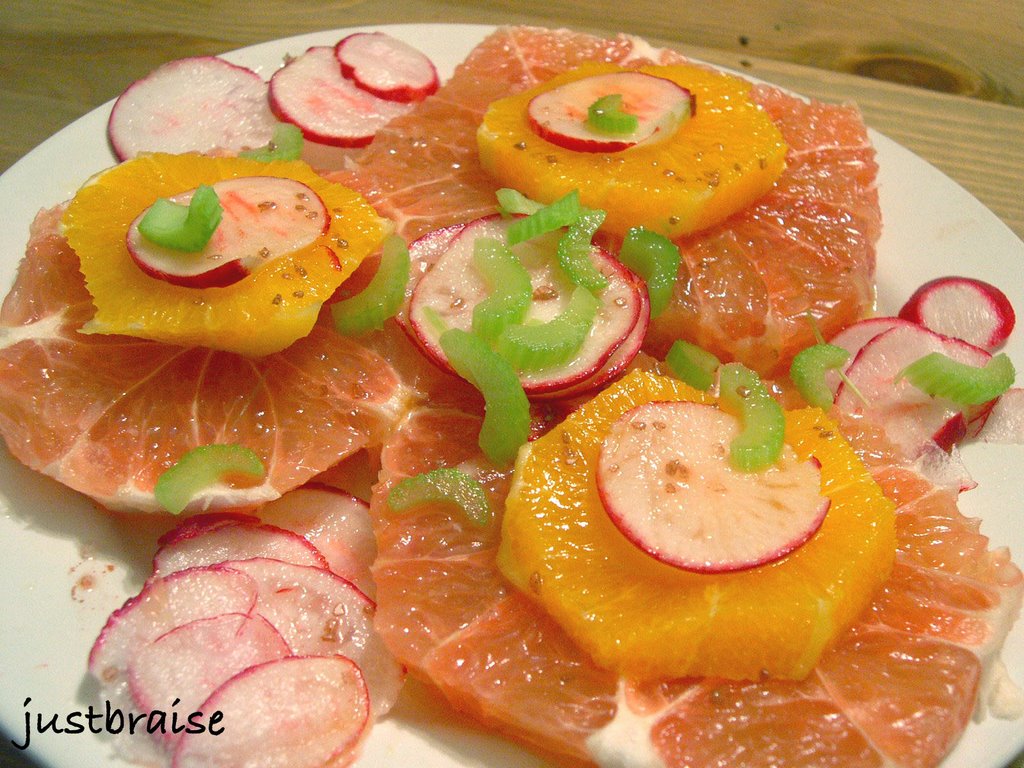
With tradition in mind, I have altered the usual fruit salad into something colorful, slightly unusual and extremely refreshing. It is great for a small budget and can be remade in variations of one’s choosing. It can be tossed (for a large quantity) or set precisely (as above).

For this recipe I used a pomelo, happy relative of the grapefruit. They are the largest citrus available; mine was just larger than a cantaloupe. Sweeter than a grapefruit, mine contained miniscule seeds that were easy to bypass and eat, making them quite enjoyable. Sliced up they are easier to consume. The dressing for this recipe is fabulously refreshing. It couples nicely with the fruit and makes an overall perfect addition to almost any summer salad.

POMELO SALAD
Makes: 2 servings. Active Time= 8 minutes.
* 1 pomelo (or red grapefruit)
* 1 orange
* 4 radish
* 1 stick celery
* 4-5 leaves fresh mint
* 1 Tbl Tarragon vinegar
* 1 Tbl fresh lemon juice
* 2 Tbl fresh orange juice
* sea salt

1) Slice the skins off the pomelo and orange. Leave whole and cut into ¼-inch thick discs. Slice the radish paper-thin. Arrange on plate or toss in bowl.
2) Slice celery into slivers; toss over citrus. Tear mint leaves and toss over citrus.
3) Sprinkle sea salt over salad.
4) In a small container mix the vinegar, lemon juice and orange juice. Pour this dressing over salad just before eating; mixing well before applying to salad.


Over at Kalyn’s Kitchen, check out some WHB action. Today’s herb? Mint.

And in non-food related news WCB at Eat Stuff brings us the world of cats. Here I seem to have encountered the end of a bitter fight. I think it might involve the new blanket basket I bought at the dollar store. Maybe it was something I said.


Head on over to Lindy Toast for the Something For Nothing wrap up!

Monday, March 13, 2006

Golden Beet Salad


I cannot recall when I ate my first beet. I know my grandmother often served them at family meals. It sat cold and wiggley in between the sauerkraut and Jell-o; the beltway of the table I despised. Often times, when the plate got away from my small hands “grandma’s specialties” were loaded on. I sat there shifting the food around, building monuments in the likeness of Jabba the Hut, until all was an indistinguishable mess. It was many years before I willingly placed a beet in my mouth.

The first time must have been in New York City. It might even have been as late as my college years. I want to say that my first beet experience was in a sweet crimson borscht. Delicious and full of vegetables, I am sure I pondered how the soup acquired its rosy hue—that is until beer was in front of me and all was forgotten.

At some point I remember watching (or possibly reading?) a segment about food and how certain vegetables alter a person’s urine. Disgusting, I know, but I have two brothers so this was cool to me. What I take away from that program today: Asparagus= yellow and pungent. Beets= bright pink. To me this was fascinating. I tried consuming bowls of borscht, but that just filled me up. Eventually, I turned to the beet.

I remember again being at my grandmother’s home (post new scientific knowledge). Behold the plate of beets! My grandmother was the only one eating them. Being the dutiful, and only granddaughter, I plunged my fork into the platter and filled my plate with beets. I consumed them faster than I could taste them for fear of ruining my experiment with a bad tasting vegetable. It was halfway through my plate when I paused for breath, tasted, and realized the sweet joy that is the beet.

Today it seems my refrigerator is never without beets. They are the best of additions to any salad, powerful enough to stand on their own, and their leftover juice (the water they are boiled in) makes a superb addition to soup stock. I often cook up more than D or I can consume in one night then hide them in sandwiches, replacing the too common tomato (highly recommended!).

So it was with great joy that I spied the golden beet my supermarket. I bought a bunch, boiled them up and served them simply as pictured: with fresh peppercorn goat cheese, sage and a sprinkle of balsamic vinegar. This salad is pleasant and refreshing. The golden beet is a beautiful vegetable on its own, or paired with the more common red beet. It has a sweeter and more subtle flavor, making it an ideal “starter” beet. It is also a beautiful royal shade, reminiscent of the upcoming spring we all long for.

Oh, and my experiment worked. I called my grandmother into the bathroom to witness my feat. She was not impressed and thought I might be ill.

GOLDEN BEET SALAD
Serving Size= 2 persons. Active Time= 10 minutes. Inactive time= 45 minutes.
* 4 small golden beets
* 6 fresh sage leaves, pineapple sage is ideal if available
* 4 Tbl plain, herbed or peppercorn goat cheese

1) In a small pot over medium-high heat, bring water to a boil. Wash beets well and trim stalks, leaving about 1 inch in tact. Add beets to water, cover; reduce heat to medium. Cook beets about 45 minutes, until a fork can easily pierce the beets.
2) Remove beets from heat and run cold water over them until they can be handled. Push skin off (once cooked, beet skin easily falls off with a little nudge). Trim off stalk and slice as desired. Arrange on plate.
3) Sprinkle goat cheese over beets, or place on side. Shred sage and sprinkle over. Add a dash of balsamic to taste.

Tuesday, February 28, 2006

Jicama Passion Salad w/ Shrimp


I will admit there are many foods I have yet to try in my life. A semi-picky eater as a child, then vegetarian for six years, left me many missed opportunities. So it is only recently that I am opening my doors to the new. Last week it was skate, over the weekend it was pork belly, and today it is passion fruit.

It is true. I must sadly come to terms to the fact that I have never (knowingly) had passion fruit before today-- okay, two days before: At a recent brunch I discussed with friend, R, how I love Looza’s Tomato Juice because it is 100% pure tomato juice—the perfect base for an excellent Bloody Mary. He dared me to try the Passion Fruit, “truly amazing.” So the next time I saw it in stock I took the challenge and bought some. Once in my mouth I was brought to the Caribbean.

So as I went shopping one day my eyes fell upon a plum-looking fruit. The sign read “Passion Fruit.” A bit pricey at $1.50 a piece; I decided it needed trying, regardless.

Originally from Brazil, passion fruit got its name from Spanish missionaries who thought the fruit resembled religious symbols, like the crown of thorns. In Spanish, it is known as granadilla or “little pomegranate,” possibly because like the pomegranate, it is the pulpy seeds that are eaten.

Passion fruits are small with an overwhelmingly sweet pulp that is often strained for juice or sauces (though the seeds can be eaten). A good source of vitamins A, C and fiber (some claim it to be the highest fiber source of all fruits) and high in potassium, the flavor and health benefits of these little wonders go a long way.

Passion fruits are available in shades of purple or yellow (a more tart fruit) depending on the variety. When purchasing, pick the largest fruit available. It should be firm and as it ripens, the skin’s ridgidity should keep, while becoming slightly shriveled when ripe. When it is ready to eat, slice it in half, scoop out the seeds, and use them as-is or strain the pulp and just use the juice. Either way, this fruit is pure indulgence that should be tried.

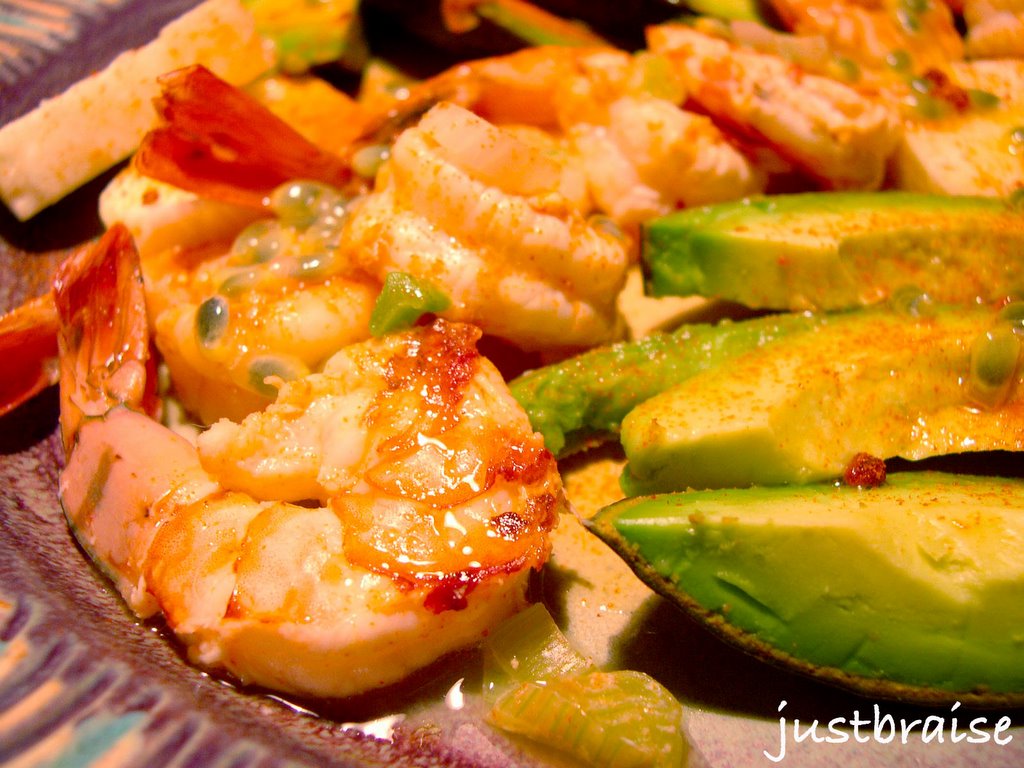
The combination in this salad was pure tropic. The light, watery crispness of jicama (hick-e-ma) pairs perfectly with the buttery smoothness of avocado. A sprinkling of cayenne pepper gives this salad a great kick. When drizzled with passion fruit seeds and a smattering of shrimp, this salad is utterly delicious.

JICAMA PASSION SALAD w/ SHRIMP
Serves 2. Active Time= 15 minutes. Inactive time= 1 hour.
* 1 lb large shrimp, peeled and de-veined
* 1- 12oz can lager beer
* juice of 1 lime
* 2 scallions, chopped
* 1 avocado, sliced ¼-inch thick
* 1 jicama, peeled and sliced ¼-inch thick
* 1 passion fruit, pulp only
* 2 tsp cayenne pepper

1) Place the cleaned shrimp, beer, lime and scallion in a bowl. Mix and let marinate in the refrigerator for 1 hour.
2) When shrimp are done, using a grill pan (or real grill) set to medium cook the shrimp, 2-3 minutes each side, until they turn pink/ char slightly and curl. Place in a fresh bowl in the refrigerator to chill while prepping the rest.
3) Peel and slice the avocado and jicama, arranging them on 2 plates. Remove the shrimp from the refrigerator and arrange it on the plate. Sprinkle with cayenne pepper and passion fruit pulp. Drizzle with lime juice (optional).

Sunday, February 19, 2006

Citrus Salad


Vitamin C is vital to staying healthy in flu season. This simple powerhouse rears its head in numerous supplements. Today, one is able to uncover vitamin C enhanced dairy and cereal products. New beverages proclaim to be “C Monster” or “Ex-C-lent.” But like most things, it is always more satisfying in the natural state.

With Chinese New Year having just past, oranges are on the mind. Thought to have originated in the orient, it is no surprise that numerous Asian dishes contain oranges in some form. It is also no surprise then that citrus translates as “wealth” and “luck” from the Chinese, which is why it is eaten in the New Year—to bring us wealth and luck. I prefer this tradition to black-eyed peas and cabbage.

At a recent dinner party a New Orleans native claimed Louisiana oranges the best in the world. Having always thought Florida, perhaps Valencia, to be top pick, I did not even know Louisiana grew oranges. I took him up on the challenge. From the kitchen he withdrew a fresh-picked orange from a recent trip home. The result? It was excellent: sweet and juicy as an orange should be. Now if he will just bring a bushel back for me…

I recently read a short comparison on blood oranges. In sight and taste tests, the California blood won over the Valencia. So with blood oranges on my mind, I sojourned to the grocery store for the pickings. I returned with two blood oranges and broke into one on my walk home. Once that outer skin was cracked and peel discarded, memory assaulted me: I was sitting in my junior high school cafeteria eating blood orange wedges from my packed lunch. Kids made fun of me and my bloody fruit, saying it was disgusting. I simply ate my crimson fruit, happy that I did not have to share, happy with my gourmet mom, happy with all things good and sweet.

In an effort to curb a recent bout of gluttony, I am making more salads in the upcoming weeks. When I was single, salads were a staple. Not so much because they are healthy, but fast and easy. The most effort put into this one is peeling the fruit. (One could also just slice off the peel to save time.) It can even pass as a dessert. This salad is simple, delicious, refreshing, and a little bit different. A culinary amateur can easily prepare this with rave reviews. And do not pass up the salt-- it is a fabulous companion to the citrus.

CITRUS SALAD
Serves 2. Prep Time= 8 minutes.
* 1 grapefruit (white or pink)
* 1 orange
* 1 blood orange
* juice of 1 lime
* 4 slices fresh prociutto
* 8-10 fresh mint leaves, chopped
* sprinkle of coarse pink sea salt (Lot’s Wyfe pink Hawaiian sea salt is recommended)

1) Peel citrus, and slice into ¼-inch discs; arrange on 2 plates. Over each plate, drizzle the lime juice and sprinkle with mint. Lay 2 slices of prociutto on each plate. Sprinkle generously with sea salt and enjoy.

Friday, February 10, 2006

The "Waldorf" Salad


I often use walnuts and dried cranberries (not sweetened Craisins) in my salads. It sweetens as well as breaks up the usual routine of tomato-carrot-celery. I once did this for my friend B from Egypt. I brought out the salad and to my delight B took a bite and was wowed: “How did you think to add the nuts with cranberries-- and pear?! This is amazing.” High on the powers of praise, I neglected to tell B that it is actually a fairly popular salad combination here in the States; I merely shrugged.

Much to my delight many a variety of the Waldorf salad is making its way onto menus across the country. Health conscious clientele are pushing the traditional mayonnaise-based dressing out of habit, calling for a more delicate covering, allowing natural tastes to break through.

The Waldorf salad’s namesake comes from the hotel it originated from: The Waldorf Astoria, in New York City. Created in 1886 by the maître d’hôtel, Oscar Tschirky, the original recipe calls for apples, celery and mayonnaise; it was later that walnuts were added to the mix. Since then, the salad has morphed into many variations.

I was recently taken to the famed Waldorf Astoria for a luncheon. The Waldorf salad was ordered out of respect for the establishment. The hotel now adds avocado to their salad, an excellent surprise. I unfortunately (or maybe happily) left that meal so stuffed I was in a food daze the remainder of the day. This meal was the catalyst to the birthday week of gluttony, ending with pants splitting along the leg seam. This incident will also cause me to take a more (somewhat) subdued and healthy approach to cooking this week, starting with this salad today.

There are too many modifications to suit specific tastes over the years that I will only say this: mix and match your favorite nuts, dried and fresh fruits, and lettuce bedding, and you will most likely produce a delicious, healthy salad. For my own, I usually stick with endive, pear and a tossing of good crumbly feta. Today I went without cheese and added radicchio (which resembles a small red cabbage with a slightly spicy taste). I also coated the salad liberally with Lot’s Wyfe New Zealand pink coral salt, and a sprinkle of Manicardi Balsamic Vinegar, my two new favorite kitchen additions. One can also make a light mustard-lemon juice-olive oil vinaigrette.

”WALDORF” SALAD
Serving Size= 2. Prep time= 5 minutes.
* 1 endive head, thinly sliced
* ½ radicchio head, thinly sliced
* ½ fennel bulb, thinly sliced
* 1 apple, thinly sliced (or pear)
* small handful of green beans, washed, trimmed and halved (optional; blanched or raw)
* ¼ cup dried cranberries (or other dried berry)
* ¼ cup chopped walnuts

1) Combine and mix the endive, radicchio, fennel, apple and green beans. Distribute onto 2 plates, sprinkle cranberries and walnuts on top. Drizzle with a good balsamic vinegar, or a homemade mustard-lemon based vinaigrette. Add salt/ fresh ground pepper to taste.
NOTE: Crumbled feta or blue cheese make excellent additions to this salad

Friday, December 23, 2005

Not So Classic Tuna Sandwich


*Just Braise has moved. Please visit me at www.justbraise.com!*


Tuna sandwiches and I were a love-hate affair when I was younger. I thought they tasted good, but then I would look in a can only to be repulsed by the resemblance to cat food. I also found it strange that I did not like regular (non-canned) fish, but could eat canned tuna. It seemed too close to Spam-- which is just repulsive. I also was unable to eat other canned fish-- like canned salmon. To this day my mother buys it and makes what she calls “salmon patties”. These truly are cat food and I am sure my current cats would engulf those patties.

I also remember being terrified of the possibility at the lunch table in junior high school to be the kid with a tuna sandwich. Kids can be cruel and there is nothing worse than the smell of tuna; too easy of a target to make fun of. The only thing I can think of that is worse is being the kid with the pickle in the lunch bag (I was also sometimes that kid). It is one thing to pull a fresh tuna sandwich (or pickle) from a nicely refrigerated space and eat it immediately, but I think parents fail to realize a child’s lunch sits in their dank locker or backpack until lunch. How many bugs crawl through there? How often is the sack smashed into place? How much food has rotted in their by previous occupants? If you have children just try not to think about this. I don’t but now shutter thinking back to my own home-brought lunches (which always far surpassed the grease-laden-grade-D-garbage they sell at almost every school across the country, even if it did sometimes smell).

Once, I think I was in high school, I attempted to make my own tuna and eat it out of the bowl one night. I dumped the drained canned tuna in, added mayonnaise, celery and pepper and proceeded to eat it. I thought it tasted too fishy and needed more mayonnaise, so I kept adding mayonnaise: 1 Tbl, 2 Tbl, 3… Now I had a bowl of mayonnaise that hinted at tuna. It went into the garbage. I had thought I wanted tuna, but turns out my taste buds were not having it.

On Sundays my mother would purchase bagels and lox from a bagel shop.in a neighboring town. This place has such good bagels there would be a line outside the door on Sundays. Since we would devour the lox in one day, she would also buy a quart of their tuna to put on the remaining bagels. That tuna was so good (and I would think still is) that it sometimes would also disappear in one day—I would often catch my little brother shoving spoonfuls of the tuna into his mouth, returning it to the fridge, then repeating 2 min later. (They pulse the tuna and ingredients into a tuna “paste” which allows it to keep the shape when on top one’s bagel.) We attempted to imitate it at home, but failed. I now believe there is an opiate in it to make it so addictive. I have never found any store-produced tuna tasting so good.

Today, when I make a tuna sandwich, I do not use any mayonnaise. In fact, there is not even a jar of mayonnaise in my refrigerator. I made it once (mayonnaise) and was totally repulsed by the amount of oil that went into it, I figured I could drink it straight for the same effect, and now try my hardest to avoid the white stuff.

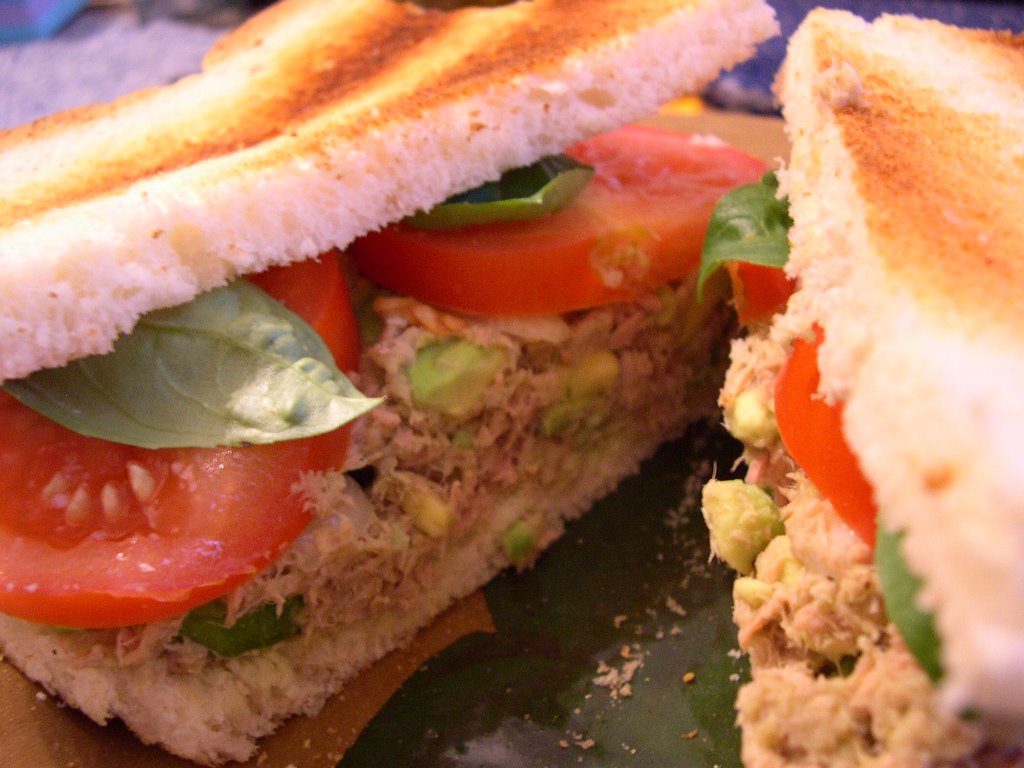
This tuna is a super protein tuna (for all you carb-phobes). It is meaty, chunky, crispy, smooth, rich, spicy and indulgent. It is made with avocado (not mayonnaise) and tastes amazing on toasted bread, in a salad or plain out of the bowl. It is one of those sandwiches you cannot wait to eat. You will dream about it coming home and turn the key a little faster to get at it sooner. Your cats will paw at you over the intoxicating smell of freshly opened tuna. The best part is, it can be altered to suite your taste or with what you have available.

NOT SO CLASSIC TUNA SANDWICH
Makes 2 sandwiches. Prep time= 5-10 min.
1 can albacore chunky tuna, drained (give the juice to your cats if you have)
1 ripe Hass avocado
1 stalk celery, chopped (a chopped pickle, olives, chopped grapes or raisins or 1 Tbl relish are other options)
1 small white onion, chopped
1-2 Tbl spicy mustard (Dijon or Deli is good)
salt/ fresh pepper to taste
2 tsp lemon juice
1 vine ripe tomato, sliced (or chop sun-dried into the bowl)
8 fresh leaves of basil
4 slices good bread, toasted (I used an Irish Soda Bread, but hearty nut-based is good)
1) Peel and deseed the avocado. Place it in a bowl and mash, it can be left slightly chunky.
2) Begin toasting bread. Add tuna, celery, onion, mustard, salt/ pepper and lemon juice. Mix until well blended.
3) Place bread on plate once toasted, add a heaping spoonful of tuna, cover with sliced tomato and basil. The result is mouthwatering, healthy and delicious.

NOTE: Hass avocadoes are rough-skinned and smaller. They have a nutty, buttery flavor. The thin-skinned large, lighter variety is not as flavorful and more watery. I have found it is best to purchase avocadoes when they are hard. This avoids ones you believe to be ripe; when in fact they are bruised. Allow them to sit on your counter (or fruit bowl) to ripen (or in a paper bag for faster results). This process will probably take about 3-4 days and the avocado skin will darken as it matures. The avocado is ripe when the skin gives under a little pressure (the innards are soft). Once they are ready, they can remain for a few more days on the counter or be placed in the refrigerator for about 2 weeks. When ripe, the skin easily peels off (once started with a knife) and the seed is easy to remove. If you do not use an entire avocado, sprinkle with lime or lemon juice and wrap it air tight to prevent discoloration. Here are some fun avocado facts.

Here we see 2 cats post-tuna juice indulgence.

Saturday, November 26, 2005

A Play on a Mediterranean Classic


In my younger days salads were a despicable nutrition source (if they could be called that). They usually composed of the basic food items I most loathed-- vegetables. Or even more usual, they were made in the same boring combination day in, day out: iceberg lettuce, tomatoes and cucumber. Can people have less imagination? And how can a restaurant dare push this off as a "house salad" making people believe there is actually nutrition value in this salad (iceberg lettuce and cucumber are essentially water-logged with few vitamins) and people are receiving their daily vegetable intake? I fail to remember, did people actually feel better about themselves after eating one of these poor excuses for a salad.

I am now older, and I like to think wiser. I have come to understand a few of the essential vitamins my body needs, and I have come to understand combinations that taste good-- who knew fruits, vegetables and nuts are delicious? And how many combinations can there be...??

This Thanksgiving, when I asked my brother to aid in the food production (did I mention I made everything this year?), I almost fell to the floor in convulsions when he turned to the iceberg lettuce, began reaching for tomatoes, and announcing he could not find the cucumbers. No, no, no! (No worries, I set him on the right path.)

Saturday I put myself in charge of the luncheon salad. It was delicious, crisp, crunchy, sweet, salty, with each item perfectly indecipherable from the next. I make these salads in various fruit-cheese-nut-greens combinations depending on my fridge's availability and you can do the same. This was today's:

EASY GOURMET SALAD
Serves 4. Prep time= 10min
2 heaping handfuls of mixed greens
1 ripe avacado, sliced
1 ripe pear, sliced
8 dried apricot pieces, chopped
small handful of pecans, whole or chopped, candied or not
top with crumbled feta (or goat or parmesan)
3 sprigs fresh thyme (optional) sprinkle on salad


I covered this with a simple dressing to enhance the flavors:
1/2 orange, juiced (or lemon)
4-5 dashes of hazelnut oil (or olive oil if not available)
dash salt
fresh pepper to taste

Either juice/ throw all over top or mix separately and put over salad when ready to eat.


View Stats
Rankingblogs.com: Defining your blogs worth..