


Showing posts with label pork. Show all posts

Saturday, February 17, 2007

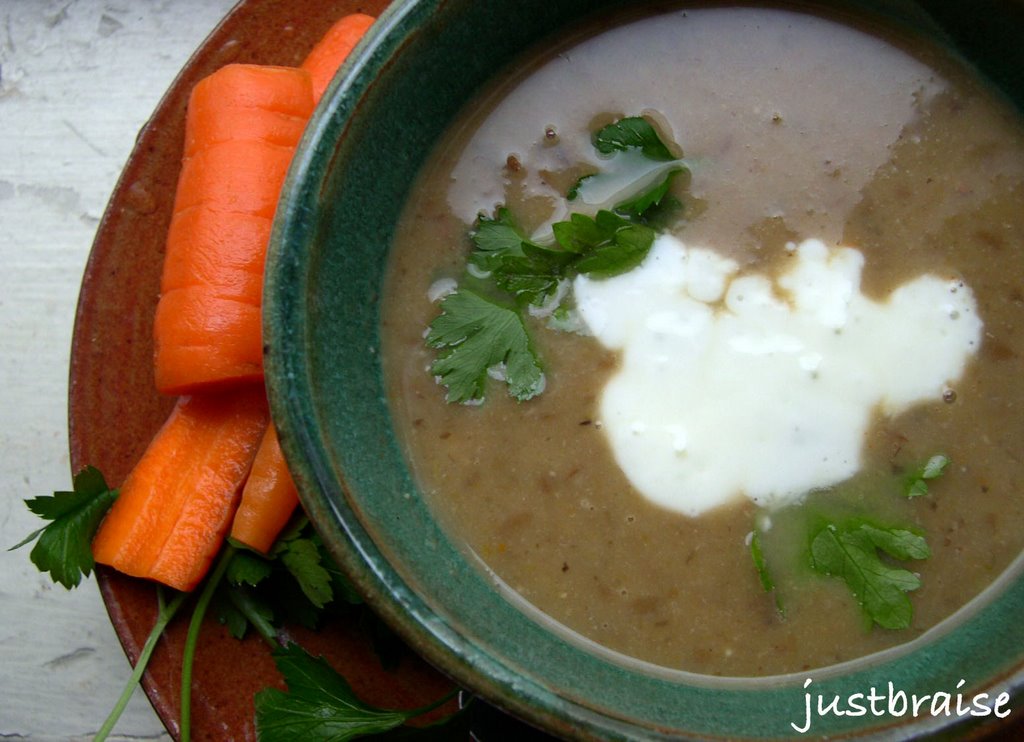
Split Pea Soup


*Just Braise has moved. Please visit me at www.justbraise.com!*

For the Chinese New Year of the Pig I’ll be finishing out my pork dishes.

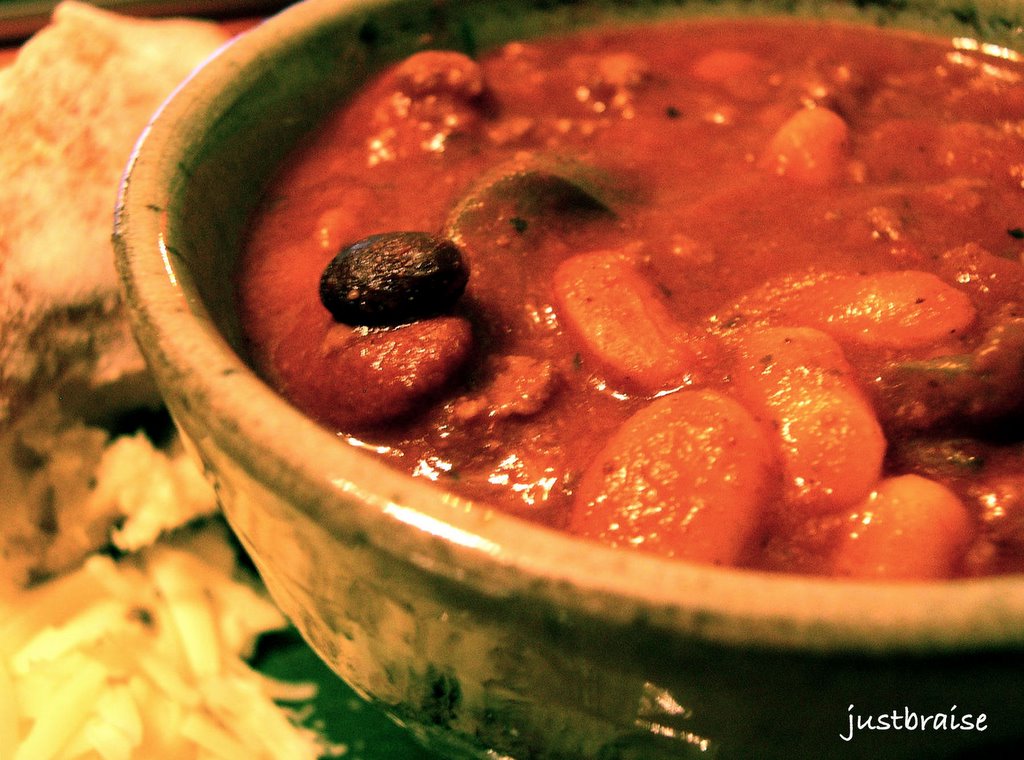
This luxurious soup was made from that citrus-sweet pork shoulder way back when. (This blog is not exactly in Real Time-- although I suppose it is possible I froze the bone).

The weather this past week has been frigid. Growing up in the Chicagoland area, I can handle the cold (my school was once canceled because it was too cold to go outside, i.e. frostbite in under 1 second). When I first moved to New York City almost 10 years ago I used to (for brief stints outside) wear t-shirts in 30 degree weather. People thought I was crazy, I proclaimed it was the Chicagoan in me keeping me warm. But when winds blast exposed skin so it feels as though it is peeling right off your face… Well, that makes we want to crawl into a small room with a blazing fire and never leave.

When it is this cold outside and you can feel the cold shoot from the pavement through your shoes and freeze your bones, hot meals are all the more soothing. There is little better than the natural heating power of a steaming bowl of soup to keep you toasty (okay, maybe a steaming mug of hot cocoa or tea). This a the perfect soup for the blah weather. It is silky rich and deliciously filling with a little croute on top or crispy bread on the side.

My freezer is full of frozen individual portion sizes of soups. Once frozen and mixed up, they often turn into a game of surprise lunches that D and I will regale in after work: “Ooooh, I had that swiss chard soup from this summer-- even better warm!” or “I thought it was the ginger carrot, but once hot I realized it was the winter squash.” The supply sometimes seems endless and the addition of this split pea is a welcomed one. How else do you think D and I have had nary a sneeze these past two winters (forgetting the recent bout of food poisoning that just reinforces the benefits of home eating).

I remember my mother used to make split pea for us in the winter. Just before serving she would float hot dog slices into the soup (how very Chicago of her). As kids, we loved it and I distinctly remember plucking each hot dog piece out with my fingers and shoving my whole fist happily into my mouth, licking it clean in the process.

These days, I don’t need that extra salty kick of a hot dog to eat this soup (I prefer the kick of a little bacon). Once the split peas soften into the broth, this soup is deceivingly thick. If I didn’t make it myself I would swear there was gallons of cream laced into this creation. In fact, the only cream is the (optional) tablespoon I floated on top before serving.

This is the kind of soup that can melt you out of the warm house, allowing you to brave the nasty elements outside. It is filling on its own, paired with a light salad or a good sandwich.

SPLIT PEA SOUP
Serving Size= 8-10. Active time= about 20 minutes. Inactive time= about 2 hours.
* 2 tablespoons butter
* 1 tablespoon olive oil
* ½ pound bacon, cut into ½ inch pieces (optional and used instead of butter and olive oil)
* 1 large sweet onion, chopped
* 2 stalks celery plus leaves, chopped about 3 inches long
* 2 carrots, chopped about 3 inches long
* pork bone, the shoulder works well
* 10-12 cups water
* 2- 12 ounce bags green split peas, washed and brown ones discarded
* ½ cup loosely chopped parsley, plus extra for garnish
* 2-½ teaspoons cumin
* salt/ pepper to taste

1) Warm a large stock pot over medium-high heat. Add bacon and cook until browned, about 8 minutes. Remove bacon set aside. Keep about 2 tablespoons of fat in the stock pot, discard the remaining, soaking it up with a paper towel. (If not using bacon, warm the butter and olive oil and continue).
2) Add onion and sauté until translucent; about 5 minutes.
5) Add celery, carrots and pork bone, sauté about 5 minutes. Add water, cover and bring to a boil. Reduce heat to medium and uncover slightly.
6) Let simmer until pork bone begins to break down and smell infiltrates the air, about 1-½ hours. Add split peas, parsley, cumin and pepper. Follow directions for cooking length on back of package, usually the peas need about 30 minutes to cook.
7) Peas will have absorbed most liquid. Add salt to taste. Remove bone and cut any remaining pork into bite-sized pieces, add to soup. Additionally, if any pork remains uneaten from shoulder, about 2 cups of bite-sized pieces can be added to the pot. Add bacon, stir until evenly combined.
9) Serve plain or with croutes and a little heavy cream and/or parsley flakes drizzled over top.

Friday, February 16, 2007

Queens Chronicle Eats III

Here's another piece I wrote, and an event at that! I'll be there chowing down on Sunday... Come on out, especially if you have Monday off!

If you live in Queens head to your local supermarket (or street corner news box) and pick up a free copy of the Queens Chronicle (Western Queens edition). The piece is in the Entertainment section (qboro): Pork Fest in Astoria This Weekend!

Alternatively, follow this link:

Queens Chronicle "Astoria Pigs Out".

Enjoy.

Wednesday, February 07, 2007

Pork Tacos w/ Mango Black Bean Salsa


*Just Braise has moved. Please visit me at www.justbraise.com!*


I notice there are far too many sweets on display on this site. It appears we eat nothing but that sweet angel dust. In the next few days I'll be adding all the delicious porky creations made from the one 6 pound shoulder discussed below.

A few that went without photos:

The first post-roast creation was a delicious sandwich that had no chance at a photograph. Served on hearty Jewish rye bread (any offended excuse the sac-religious combination), Korean pears ( mentioned here ) and a generous smothering of honey mustard. A few minutes in the toaster oven set this to a perfect sweet-crisp combination.

Another hog-a-licious idea was to be pulled pork sandwiches smothered in a hickory BBQ sauce. Instead, we mixed the pork with avocado, lime juice and tomatoes and wrapped them in the tortillas that remained after the pork tacos pictured above. Similar to the tacos, yet a totally new flavor combination and equally delicious.

The pork tacos appearing above are served with a healthy scoop of a black bean mango salsa and a dusting of cilantro. They compete with the chorizo taco from my favorite taco truck down the street.

It goes to show you can eat well on a budget and create a symphony of tastes with the result. There are plenty of dishes that were not created that would be just as delicious: pork fried rice, rice and beans, breakfast hash, hammy macaroni, a number of soups (a rich split pea to come), empanadas, pork dumplings or piradzini (Latvian pork puffs, also to come).

A $20 pork shoulder can take two people far.

This black bean mango salsa is a great summertime side. It is great with the addition of corn and can be used for a number of taco combinations, my favorite being a grilled shrimp.

BLACK BEAN MANGO SALSA
Prep time= about 10 minutes.
* 1 ripe fresh mango, cut into ¼-inch cubes
* juice of 1 lime
* ¼ red onion, cut into ¼-inch cubes
* 1 can low-sodium black beans, washed and drained
* 1 ear of fresh corn, sliced from stalk (optional)
* 8 grape tomatoes, deseeded and cut in quarters (optional)
* ½ cup fresh cilantro, chopped loosely (optional)

1) Slice the mango and put it into a medium-sized bowl. The meat surrounding the pit can be squeezed into the bowl. Add lime juice, chopped onion, black beans, corn, tomatoes and cilantro. Stir and serve.

Wednesday, January 31, 2007

Lemongrass-Sugarcane Roasted Pork w/ Purple Sweet Potatoes


A few weeks back D and I found ourselves in Flushing, Queens. Flushing is the China-Korea-Thai Town of Queens. Larger and more crowded than New York City's, it seems to extend into Elmhurst and almost reach Jackson Heights where the Indian and Pakistani shops begin to mix with Columbian and Irish. We were in Flushing for Shabu Shabu, or hotpot.

In Japan they call it Shabu Shabu because of the sound the cooking food makes when it hits the water. In Korea it's called Shin Sul Ro, and is often a spicier creation, based in kimchi. In China it simply translates as "hotpot." All forms date back thousands of years from Emperors' banquets to Ghengis Khan's soldiers sharing a meager meal.

It's essentially one and the same: a steaming bowl of water or mildly flavored broth (today kept warm with a hot plate, not fire) brought to diners with added accoutrements: crab, tripe, chicken, fish balls, duck, vegetables, for example-- or a taste of all of the above. Various seasonings/ sauces from salty to sweet to spicey are added to your delight.

Originally, the hotpot was a shared dish and in China you can still find hotpot establishments "in the old way" with one pot for all diners (I have only seen it in China). Today it is more common that everyone is provided their own pot, as it was the day we were in Flushing.

Hotpot is the perfect cold weather meal. It warms the soul, fogs the glasses and leaves you full and as satisfied as Buddha.

The last time I took D for hotpot he was mildly terrified. We had just started dating and I took him into the depths of New York City’s Chinatown, under the Manhattan Bridge. His glasses fogged immediately as we entered the steamy dining room and being unable to see, and unable to understand the language around him, he meekly walked to the table pointing unconvincingly as he ordered pork from the waitress. I happily showed him the sauce counter, explained how to mix items, how long to cook them for and suggestions for mixing sauces.

Needless to say, when I suggested it again, he wasn’t too thrilled. I convinced him by offering to buy him some frozen handmade dumplings at the grocery and we were good to go with an explorative gourmand friend, R, in tow.

This time it was D explaining to R what he was in for: Jumping in by ordering extra fish balls, hitting the sauce station first and explaining how to best put creations together. We left, D received his 10 lb bag of dumpling reward, and I became mesmerized by items in the grocery aisles (which is none too difficult for me).

D and I scoured the soy sauces until we found a boutique variety without caramel coloring. We watched eels swim in their containers and crabs being tossed back and forth. In the fruits and vegetables I fought over plump kumquats and Korean pears on sale 4 for $1 (everyone else was doing it so why not join the fray?). I ogled the massive selection of seaweeds, keeping them in mind for a future visit and grabbed up some lemongrass.

I told D to keep a lookout for purple sweet potatoes. We had them at a restaurant once (where they called them Okinawa sweet potatoes. I was so fascinated by their rich color I could not believe there was no dye in them. He found them hiding behind a beige skin and we grabbed two large specimens. As we headed out my eyes landed on sugarcane sticks. My mind wandered to mojitos served with cane “straws” and I grabbed a package. Finally, D cut me off.

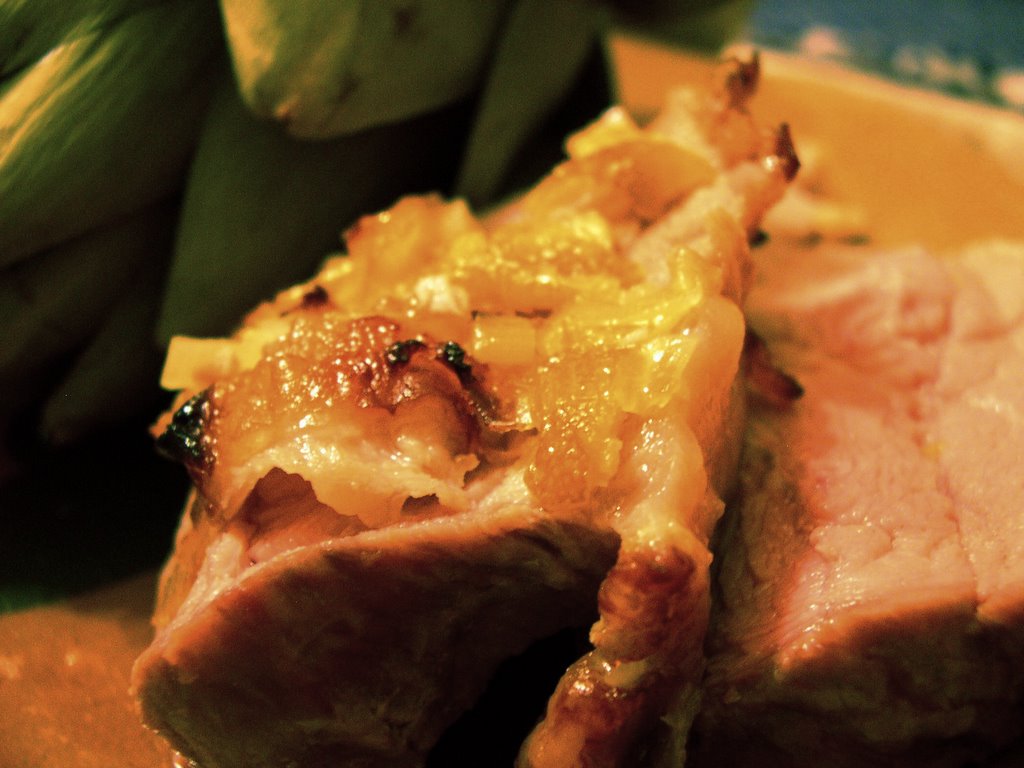
The next day we picked up a pork shoulder and remembering all my new treats in the fridge, I suggested we make a tropical glaze for the pig. I used the lemongrass, sugarcane, a lime and a bottle of cheap Brazilian beer to extract the flavors. I think allowing the meat to marinate in the resulting liquid would have been more successful, still, the pork turned out sugary sweet around the edges and perfectly juicy inside. While roasting, we wrapped a purple sweet potato in tin foil and threw it on the pan for baking.

The purple sweet potato is truly unique. It is sweeter than traditional sweet potatoes we are used to here in the U.S. with more of a honey overtone. It makes a beautiful presentation and would be perfect for a special Valentine’s Day meal. A few days later we sliced the second potato thin and fried it in some reserve bacon fat. The result was deliciously light and reminiscent of the Terra vegetable chips one can find in the markets.

LEMONGRASS-SUGARCANE PORK ROAST
Cook time= about 3 hours
* 1 pork shoulder, about 5 lbs
* 3 sticks lemongrass
* 2 sticks sugarcane, about 5 inches long, 1 inch thick
* ½ a lime
* 1 inch cube fresh ginger
* 2 Tablespoons honey
* 1 bottle lager beer

1) Using a sturdy blender, like a Cuisinart, puree lemongrass, sugarcane, lime (rind, juice and pulp), ginger. The result will be a mealy, fibrous consistency.
2) Warm a skillet on medium heat. Add puree and cook about 4 minutes, stirring often, until aroma begins to fill the room. Add beer and bring to a simmer. Cover and turn heat off, allow to sit 10 minutes. Warm again until just a simmer then remove from heat.
3) Line a large bowl with cheesecloth and place lemongrass-sugarcane puree into cheesecloth. Strain liquid, pressing the cheesecloth tight.
4) Warm an oven to 350F.
5) Wash and pat dry pork. Slash 2 inch diamonds along fat. Cover with ample salt and pepper.
6) Pour about half the lemongrass-sugarcane liquid over the pork, making sure some remains on top and inside the fat slices. If you have a syringe, inject some of the liquid into the pork. Reserve ¼-½ the liquid for later basting.
7) Bake on middle rack, basting 1-2 times, until pork’s internal temperature is 165F.


Oh, and Happy Birthday to me!!!
D and I are low-keying it today with a brunch out and lobster dinner at home. Okay, maybe that's not totally low-key.

Sunday, October 15, 2006

Braised Pork Chops w/ Apples


*Just Braise has moved. Please visit me at www.justbraise.com!*

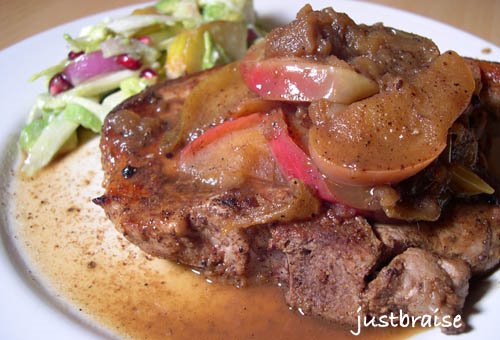
There are few things that complement pork chops as well as apples. Pork chops with applesauce is standard fare. And after years of this mundane preparation, I had essentially sworn off pork chops. It was not until I met D, with his penchant for pork that I began to eat “the other white meat” and truly appreciate it.

Over the years we have worked on our now standard pork chop recipe. Believe it or not, I clamor for it more often that D does these days. No sauce is used, but fresh apples-- All the better while they are in season and abundant. This fall, the recipe has truly reached perfection, braised in cider and rum, the result is sweet, moist meat with a sauce that deserves sopping.

Pork chops are easy to ruin. Overcooking creates dry, gristly meat and is all too common. To braise a pork chop then, is to eradicate the fear of overcooking while providing a savory sauce to accompany your meat.

This is a recipe I discussed previously. When D first made these chops, they were devoured in seconds. Again, D was in charge of the meat and I was happy sous chef to the operation. And again, I dare you not to devour these in seconds.

I think to truly make this dish perfect would be to serve it on top a bed of polenta. This way, all juices can be appreciated and none lost. This dish is a fabulous seasonal dish, so make it post haste.

BRAISED PORK CHOPS W/ APPLES
Serving Size= 2. Active time= about 10 minutes. Braise time= 15 minutes.
* ½ tablespoon unsalted butter
* olive oil
* 2 thick cut pork chops on the bone
* ½ teaspoon cinnamon
* 1 teaspoon cumin powder
* 1 teaspoon coriander powder
* salt/ pepper
* 2 good cooking apples (Granny Smith, Empire, Rome, Courtland), sliced into 16 wedges
* ¾ cup dark rum
* ¼ cup spiced apple cider

1) Preheat oven to 350F.
2) In a deep oven-safe pan (or dutch oven) over high heat, warm butter and olive oil (to barely coat bottom of pan).
3) While pan is warming, prepare the pork chops: Wash and fully dry the meat. Coat evenly on both sides with cinnamon, cumin, coriander, salt and pepper. Carefully place meat in pan and sear both sides until thoroughly browned; about 4 minutes each side. This seals in the pork chop juices and allows you to properly continue the braising. Do not be afraid to really brown the chops in this step.
4) Remove the pork chops from pan and reduce heat to medium. Deglaze by adding rum and scraping bits that have stuck to the pan up and into the rum. Add cider and apples. Braise the apple wedges in the juices until they are limp and have absorbed some juice; about 4 minutes.
5) Return pork chops to pan and move apples around the meat to cover sides and top (some may remain under the chops).
6) Cover pan and place in oven for 10-15 minutes until pork chops are juicy and succulent and liquid has reduced and holds a sweet, thick aroma. Serve with the apples crowing the meat and the sauce all around. Delicious.


Head on over to Sweetnick's for Tuesday's ARF round up!

Check out other Fall Feast-ival items over at WellFed's FitFare!

Tags: , , , , , .

Tuesday, August 22, 2006

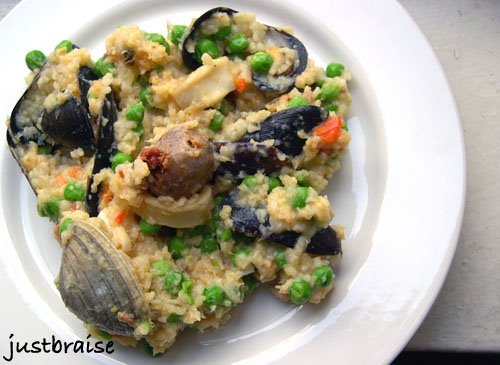
Paella de Pescados y Mariscos con Chorizo (Fish and Shellfish Paella w/ Chorizo)


My favorite thing about Spanish food is not the paella. Nor is it the Valencia orange, omelette or great variety of delicious tapas available-- though these things are all delightful. My favorite thing about Spanish food is the olive.

This unassuming fruit, a call to peace, is plentiful in the Mediterranean region. Squat trees line roadsides for miles and the bitter little drupe almost appears as a small plum from afar: an iridescent purple as it fades into its ripe green. Harvested with a shake to the tree bough it arrives to us along the culinary path marinated, as tapenade or oil.

In Spain, as you enter almost any food or drink establishment, olive pits abound.

A few years ago, my mother and I planned a quick trip around Spain. A country both of us had always wanted to visit, but never had the opportunity. For me, it was a culinary and ceramic feast I planned around clay factories, orange groves and funky architecture. For my mother, it was a wearing down of her feet stomping through the cities and country back roads with the salvation being sangria and tapas along the way (though she too enjoyed the clay factories and architecture).

On day one, hungry from a morning of walking, we stopped for lunch at a recommended establishment: “Oh! How disgusting!” my mother gasped as we walked inside, “this floor is covered in pits!” We shuffled in, unable to understand the debris covering the floor and took a table across from the bar, ordering up a jug of sangria and a seafood paella.

We waited for our food and heard the definite “pffffmmmp” of a person triumphantly releasing a pit from mouth into air. Our noses turned up in question, we looked at each other, then scanned the restaurant for the perpetrator. There he was, tan and stocky with a perfectly edged beard looming in the shadow: “pfffmmmp” he turned and released his bleached teeth in a wide grin towards us.

A bowl of olives came to our table along with the sangria. I popped a few olives into my mouth, but finding nowhere to discard the seeds, I held them in my cheek, a squirrel at harvest. More patrons entered the establishment. Soon that pfffmmmp echoed throughout the restaurant, shooting from the trunk of men and women alike, regardless of age, no one seeming to care except for the clueless Americans. I looked at my mom and shot out five pits in bulleted repetition: pffp pffp pffp ffllmp fllp.

We soon realized it was custom in Spain. Olives abound and are ingrained in the culture. A complimentary bowl is provided at coffee shops, bars and restaurants in lieu of bread or peanuts. The more olives I stuffed into my face the more I fell in love with Spain, pfffmmping them out with the best of the locals. (My mother on the other hand, continued her dismay at the littered floors and begrudgingly returned the bare pit to a cupped hand where it delicately dropped to the floor unnoticed by anyone.)

This past July, a college friend married a Spaniard. The wedding was a great bi-lingual affair of misunderstandings and general good humor at each person’s attempt to befriend a person from another country with little to no verbal language skills. Communication fell remarkably well and eventually I got onto the subject of olive pits on the floor.

“Yes!” my new Spanish friend exclaimed, “it means how good the place is.” He went on to explain that some establishments will even go to the trouble of adding pits to the floor, be it from the mouths of their employees or the previous night’s collection. Pits on the floor is a rating of popularity-- the more pits, the more favored the premises.

Here is a recipe in memory of that first paella and the realization that it is okay to spit out your leftovers in some cultures. And as the season turns, I may even surprise you with some home-marinated olives. Until then, paella it is.

NOTE: Though I cannot remember if the paella I had in Spain was this moist, I enjoy the wet rice base. In this fashion, the rice sticks to everything, including the inside of the mussel and clam shells, forcing you to work for your food: sucking and rotating shells in your mouth to indulge in every bit. D and I found this much more enjoyable, and a more entertaining activity than simply wolfing down the dish without thought. We also felt it made you appreciate the variety of seafood present. I also enjoy eating with my hands, so take away what you will.

This paella is based on a recipe found in the Cuisines of Spain cookbook by, Teresa Barrenechea. It is essentially the same recipe with a few additions, namely peas, onion and chorizo.

This paella is fairly labor intensive, though if you make a large batch and have leftovers for the week it is worth it. We found that it is absolutely necessary to use fish stock and not chicken or vegetable. We felt the stock really enhanced the fish flavor throughout. Also, fresh seafood is essential.

PAELLA DE PESCADOS Y MARISCOS CON CHORIZO (FISH & SHELLFISH PAELLA w/ CHORIZO)
Serving Size= 8 persons. Active time= about 1 hour. Inactive time= 12 mintues.
* 1 dozen littleneck clams
* 2 Tbl coarse salt
* 6 large cloves garlic, unpeeled
* 9 cups fish stock (recipe below)
* 2 pinches saffron threads
* 2 pound mussels, scrubbed and de-bearded
* 2 cups water
* ½ cup olive oil
* 1 large red pepper, seeded and cut lengthwise into narrow strips
* 1 medium Spanish onion
* 8 ounces, about 4 links, chorizo, cut in half
* 1 pound monkfish (or grouper), cut into 2 inch chunks
* 1 pound large shrimp
* 1 pound small squid, whole and rings
* 1-½ tsp salt
* 4 cups Spanish (short grain) rice
* juice of 1 lemon plus extra for garnish

1) Preheat oven to 500F.
2) Clean clams under cold water. Discard any open clams, or those that do not close when touched. Place clams in a large bowl with the coarse salt and let stand for 30 minutes or up to 2 hours. Clams will release sand trapped in shells.
3) Place garlic in a small heat-resistant bowl or baking dish and roast in oven for 10-15 minutes; until skins are browned. (Alternatively, you can throw a whole garlic head in, chopping the top off for easy removal, and use the extra as a spread mixture with olive oil.)
3) In a small saucepan, bring stock to a boil. Add saffron and decrease the heat retain simmer.
4) When garlic is ready, remove from oven (leave oven on). When cool enough to handle, peel cloves and place in blender with ½ cup simmering stock. Process until blended.
5) In a medium saucepot, place mussels (discarding any that fail to close when touched) with 2 cups of water on high heat. Bring to a boil and cook 5 minutes, until shells open. Using a slotted spoon, lift the mussels and set aside (add mussel broth to stock or freeze for later use).
6) In a large paella pan or stock pot, heat the olive oil over medium heat. Add bell pepper, onion and chorizo, stirring occasionally for about 10 minutes, or until chorizo has cooked through and the aromas are strong. Add monkfish, squid and salt, increase heat to medium high. Sauté 5-10 minutes, until monkfish turn opaque.
7) Add rice and stir to blend, allowing rice grains to incorporate into the oils present. Add hot stock, increase heat to high and bring to a boil. Add garlic mixture, stir gently to incorporate and boil for 5 minutes without stirring.
8) Drain the clams. Add shrimp to pot, stir gently to incorporate. Add mussels and clams around the top of the pot. Place in oven (uncovered) for 12 minutes; rice will be absorbed and clams and shrimp will cook.
9) Remove from oven and discard any clams that do not open. Sprinkle lemon juice over top. Cover with lid or towel and let sit for 7 minutes. Serve with lemon as garnish


FISH STOCK
Serving Size= 2 Quarts. Active time= 10 minutes. Inactive time= 20 mintues.
Note: White fish is ideal to use: snapper, cod, hake or bass. Avoid fatty fish, such as tuna, sardines and salmon, among others.
* 2 pounds fish frames and heads
* 1 cup shrimp shells (can clean your shrimp from above and use)
* 1-½ cups mussel broth (see above)
* 1 large Spanish onion, coarsely chopped
* 2 carrots, coarsely chopped
* 1 bunch flat leaf parsley
* 3 Tbl olive oil
* 2 quarts water
* salt/ pepper to taste

1) In a stockpot on medium-high heat warm olive oil. Add fish frames, shrimp shells, onion, carrots, parsley, salt and pepper. Stir until shrimp shells turn pink. Add water and bring to a light boil.
2) Using a slotted spoon, discard any foam that forms on the surface.
3) Decrease to medium-low heat and simmer, partially uncovered, for 30 minutes, skimming foam off as needed. (Do not overcook or stock will turn bitter)
4) Strain the stock and season with salt as necessary.


Head on over to Sweetnick's for today's delicious ARF roundup!

Tags: , , , , .

Thursday, June 29, 2006

Chorizo-Lime BBQ Ribs


*Just Braise has moved. Please visit me at www.justbraise.com!*

Summer brings a new culture onto the streets of New York City. It lives and breathes the pavement and it waits out the humid days for the cooling nights, begging for a release with rain. People move from their cramped apartments onto stoops, lawn chairs, handball courts, public pools, beaches, parks— even an air conditioned store to roam aimlessly for a cool down.

I walked home the other day and witnessed my neighborhood in a new light. Every winter we tightly latch ourselves into our undersized apartments, bundled under blankets and layers of clothing. I begin to forget the people that live in my neighborhood-- that I pass everyday on the streets-- that I ride the train with into Manhattan while we forget where we are and where we are going. As summer’s heat finally hits hard, the close quarters are too much and private life blends into public.

My neighborhood is a multicultural whirlwind of ethnicities and personalities. A perfect microcosm of New York City, I can walk two blocks in one direction to restock my sheesha; two blocks in the other for the best gyro in the City (or the best frappe according to the New York Times). I can go to the Mexican bodega for $1 tamales on the weekends, the Bangladesh deli for a fresh mango smoothie, or the Indian bakery for fresh gulab jaman. The list continues into the night.

But what emerges in the summer holds more than the variety of stores I relish. It is a look into the lives of others. Purple-haired women drink orange soda as their granddaughters regale their waning days of the school year. A group of kids playing soccer in the streets knock their ball too close to a passerby. A mother sits on the stoop as her son practices handball against their brick building. Young girls seek out the icy man for fresh coconut ices. Neighbors rehash old ties, friendly waves cross intersections, the weight of clothing is reduced, it is summertime and the people are happy.

The heat draws people out of their home physically and mentally. Each day I pass the local bargain shop and spy the cheap charcoal grills, waiting for the perfect time to purchase the one-season specialties. Spending time in the kitchen is cut short as the heat of the oven is viewed as sin. Hamburgers, quick chickens, easy seafood and of course, ribs, are easy on the mind because they lend us the notion of lazy-weekend-outdoor-eating with friends and loved ones.

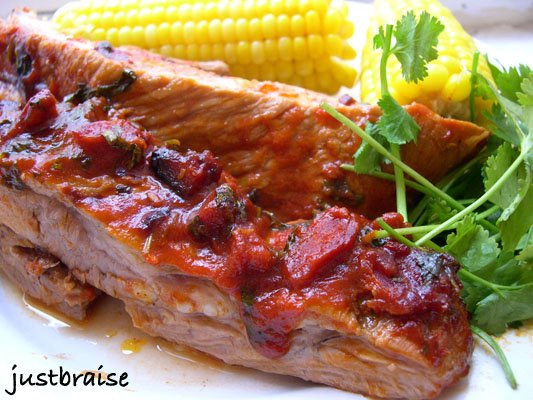
With that said, I justify yet another round of ribs (pork this time)—perfect for a 4th of July BBQ. This one is dripping tangy citrus flavors off the chin with every bite. It is a thick and chunky sauce, loaded with freshness that screams homemade. It is something to impress friends with and all too easy to make. D believes the sauce recipe is too heavy on tomatoes, but I think it sits perfectly on the ribs— with that said, do what you will with the quantity.

CHORIZO-LIME BBQ RIBS
Serving size= 4 people. Active time= 35 minutes. Inactive time= 1 hour 20 minutes
CHORIZO-LIME BBQ RIBS
* 5 pounds pork ribs, have the butcher crack the bone but do not separate the ribs
* Chorizo-Lime BBQ sauce (recipe below)

1) Preheat oven to 400F. While oven is warming, begin to prep sauce ingredients below. Place rack of ribs on a large oven-proof baking sheet with a rim, cover with tinfoil. When oven is ready, place ribs on center rack for 15 minutes.
2) As ribs are baking, finish up the sauce on the stovetop. The sauce should be ready around the same time as the ribs in the first part of the baking process.
3) Remove the sauce from the heat and the ribs from the oven (once the 15 minutes are up). Lower oven temperature to 350F. Remove tinfoil and generously coat the ribs with the sauce. Cover with tinfoil and return to the oven for 1 hour.


CHORIZO-LIME BBQ SAUCE
Serving size= 4 people. Active time= 30 minutes.
* 7 ounces, about 4 chorizo links, diced small
* ½ bunch cilantro, chopped
* 2- 6 ounce cans tomato paste, no salt added
* juice of 3 limes
* 1 cup cider vinegar
* 2 Tbl molasses
* 2 Tbl spicy mustard
* 1 Tbl favorite hot sauce
* ¼ cup water
salt/ pepper to taste

1) In a sauce pan on medium heat, warm the chorizo and cilantro until the cilantro wilts and aromas escape, about 3 minutes.
2) Add remaining ingredients. Bring to a boil then remove from heat. Coat ribs and bake or enjoy as extra dipping sauce on the side.


Head on over to Kalyn's Kitchen to catch this week's WHB roundup!

Monday, April 24, 2006

Mediterranean Pasta (or Red Pepper-Broccoli Rabe-White Bean & Procuitto Pasta)


There are some people that live and die by pasta. It is their favorite food, it is served at every meal-- it is utterly perfect. For myself, I (still) cannot really understand the effect pasta has on people. I have the same non-chalance with white rice. Sure, I can add butter and salt and it has a great flavor, but… it’s just... there. Does that make any sense? I mean, sure, it tastes good, but in a head-to-head with another starch: warm crisp bread or a baked potato; I’ll take the bread or potato.

Now, I know pasta is not just pasta, and it can be dolled up to create something beautiful on its own. Just like adding olive to bread, tomato paste, spinach or octopus ink added to pasta, all of a sudden creates an attractive taste sensation on the tongue. It is no longer mere pasta. This I accept.

But because of my initial blasé attitude towards pasta in general, I tend to walk past the pasta shelves with hardly a glance; even when they may have “enhanced” pastas. So when D complained that I “don’t let him eat pasta” I was slightly appalled (and quite content) that my own stance had taken hold: D finds his way to the grocery store just as much as I do and I have never not allowed him to buy anything he may want.

So when I was making a run for some flour my eyes were averted by my grocery’s newly expanding organic section. I noticed organic wheat pasta and figured I would give it a try. When I returned with pasta in tow and shared the news with D he could barely fathom his good fortune: “really, pasta?!” You would think we had been living on rations for months and had finally found the black market.

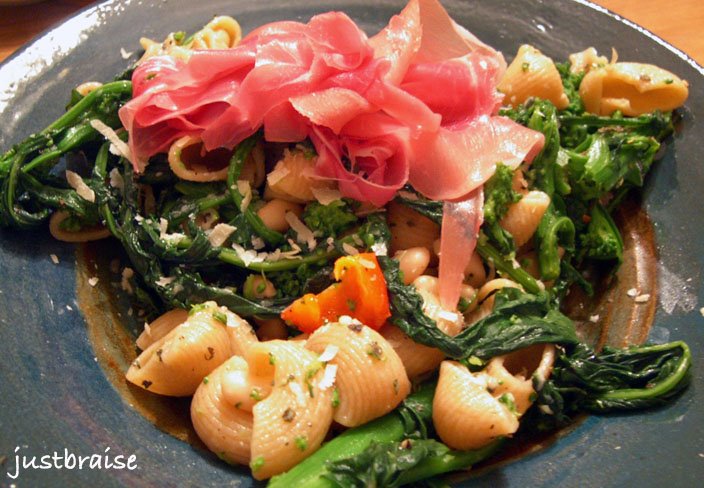
I must admit, there is so much flavor in this dish, the pasta is hardly noticed. If pasta was served like this all the time, I might eat it more often. Because there is no sauce beyond a drizzle of olive oil and sprinkle of Parmesan and fresh herbs, this dish is a pure breeze in terms of cleanup—it also tastes great warm or cold. The broccoli rabe offers a sweet bitterness that can hold its own against the salty procuitto. The white beans are little bundles of surprise as they dance in and out of the pasta “cups”. Most importantly of all, this dish was a rainbow of colors on the plate and palate.

MEDITERRANEAN PASTA
Makes: 4 servings. Active Time= 15 minutes. Cook Time= about 10 minutes. (Depends on pasta variety.)
* 2 cups pasta
* 6-8 stalks Broccoli Rabe, washed (left whole or chopped into large 2-3 inch pieces)
* ½ Red Bell Pepper, chopped into bite-size pieces
* 1 16-oz can White Beans, washed and drained
* 8 slices Procuitto
* 3-4 Tbl olive oil
* Parmesan to taste, freshly grated
* 2 tsp fresh thyme
* salt/ pepper to taste

1) Prepare pasta according to package instructions. While pasta cooks, prepare the vegetables. (If using fresh pasta, prepare after vegetables are combined, just before serving.)
2) In a large-sized skillet on medium-high heat, warm 1 Tbl olive oil. When hot, Add broccoli rabe and red peppers. Cover and allow to cook until broccoli rabe darkens and begins to wilt; about 4 minutes.
3) Add white beans to the vegetables. Stir, cover and cook another 3-4 minutes; until beans are warmed through. Turn heat low and keep covered until pasta is ready.
4) Drain pasta once ready and wash with cold water (this stops the pasta from cooking without cooling it down too much). Throw warm vegetables over, add a about 2 Tbl Parmesan (allow people to add most of their own quantity), olive oil, salt/ pepper and thyme. Toss to mix.
5) Serve up, adding Procuitto at last moment over the pasta (since Procuitto is already smoked, you want it to retain this flavor. Add it at the last moment to avoid cooking it.)


Head on over to Sweetnick's for today's ARF roundup!

Saturday, March 25, 2006

Sunchoke (Jerusalem Artichoke) Soup + WCB #42


For some reason, Sunchokes, otherwise known as Jerusalem Artichokes, were all the rage this season. They popped up on menus throughout the New York City area, from soups to sides to salads. I cannot remember how I came to know of them. Once I did, it was an impossibility to find them. I searched everywhere: green markets, my local produce stands, Whole Foods and other organic stores. It seemed that every restaurant had nabbed them up before I could touch them.

I went weekly into certain groceries, asking for sunchokes, more often than not, I was pointed to artichokes. “No! They look like potatoes crossed with gingerroot,” I would lament. But everyone just shrugged. Once I received: “we’ll be getting those in next week.” The next week, I was again pointed to artichokes.

With the sunchoke season quickly coming to a close (the best time to get fresh sunchokes is October through March) I came to accept that I would go through another season without my own bounty. Having stopped my search, low and behold, I finally found them! Doesn’t it always seem true that your desire is fulfilled when you stop searching for it?

I packed them up and brought them home, ready to make a soup as creamy and delicious as a potato soup. So why not use potatoes already? Well, simply put, sunchokes contain more health benefits than potatoes; diabetics often substitute sunchokes for potatoes.

Sunchokes are the root of a plant that resembles a sunflower and the name is derived from the Italian word sunflower: girasole. Sunchokes have a nutty and slightly sweet flavor, allowing them to pair nicely with almost everything from bacon to nutmeg.

Sunchokes store carbohydrates in a form of inulin, a starch that our bodies do not use. Because of this, they are filling, but are not absorbed by our bodies, and show indications of assisting in blood sugar control. Sunchoke flour is also available in some specialty stores, making a good substitute for people allergic to wheat. They are high in iron and potassium and low in fats. Sunchokes also contain a healthy bacteria, lactobacilli , which provide balance in the intestinal track and aid in digestion.

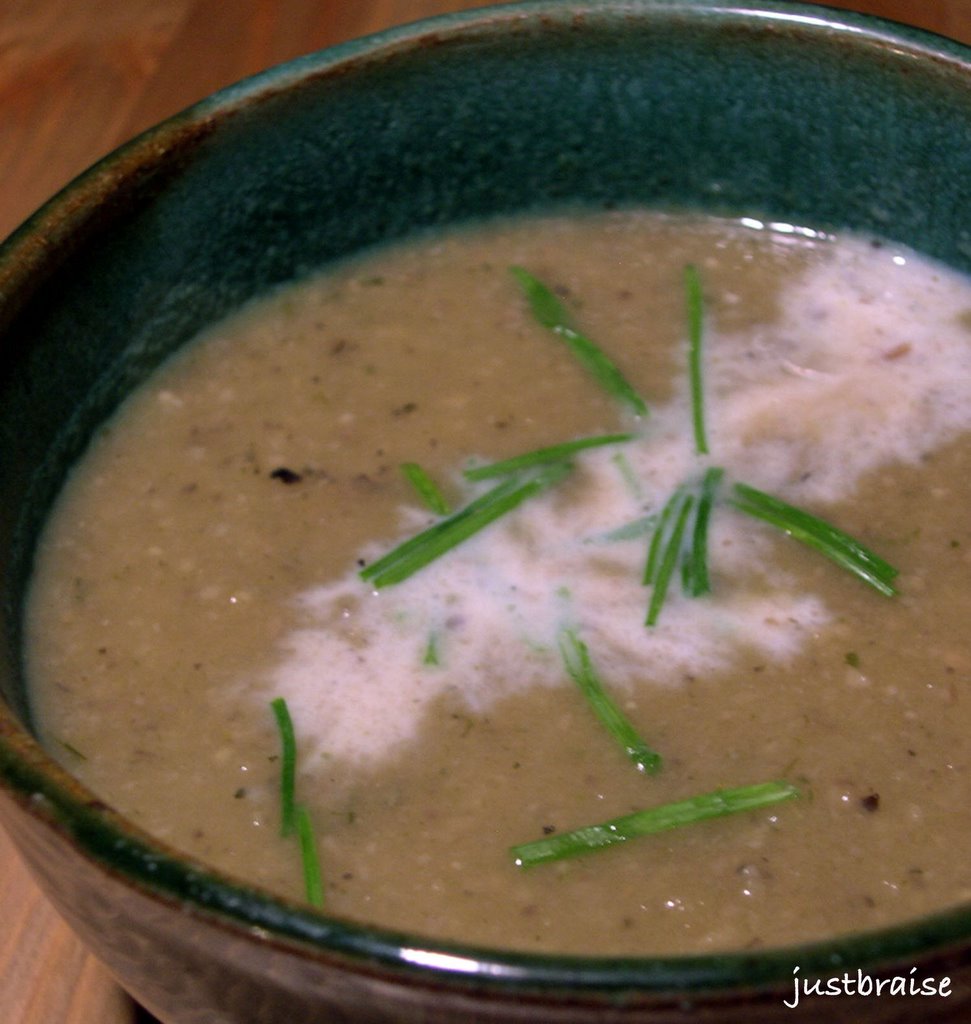
Don’t shy away next time you see this tasty tuber. It is delicious and good for you. If you make it in this soup recipe below, as D will tell you, it is the best soup yet, sweet, creamy and extremely filling on its own-- just don’t tell D you made it unless you want a dinner guest!

SUNCHOKE SOUP
Serving Size= about 12. Active Time= 25 minutes. Inactive Time= 45 minutes.
* 3 ham hocks, have your butcher cut them up
* 8-10 slabs of bacon
* 1-½ lbs sunchokes, scrubbed and cut into 1-inch chunks (no need to peel)
* 1 medium white onion, chopped
* 2 carrots, chopped
* 2 stalks celery + leaves, chopped + extra leaves if you have them
* 10 cups water or leftover vegetable juices
* 2 cups buttermilk

1) Turn the oven to 400F. Place the ham hocks on a roasting pan and place them in the oven while you prepare the soup. In a soup pot on medium-high heat, brown the bacon, about 8 minutes. Once complete, carefully using a paper towel, absorb about half of the bacon fat, leave the rest for the soup.
2) Add onions, carrots and celery. Sauté 8 minutes with the bacon and bacon fat.
3) Remove ham hocks and add them to the pot (turn the oven off). Add sunchokes and water (or vegetable juices). Bring to a boil then cover and reduce heat to medium-low. Cook until sunchokes are soft when pierced with a fork; 30-45 minutes.
4) Remove ham hocks and bacon, set aside to cool. While ham is cooling, carefully in batches, or with a handheld blender, purée the contents of the pot. Add buttermilk; stir.
5) Pick through the ham hocks and remove any meat, throw it back into the soup. Chop the bacon into bite size pieces, return to pot.
6) Garnish with parsley or 1 Tbl buttermilk.


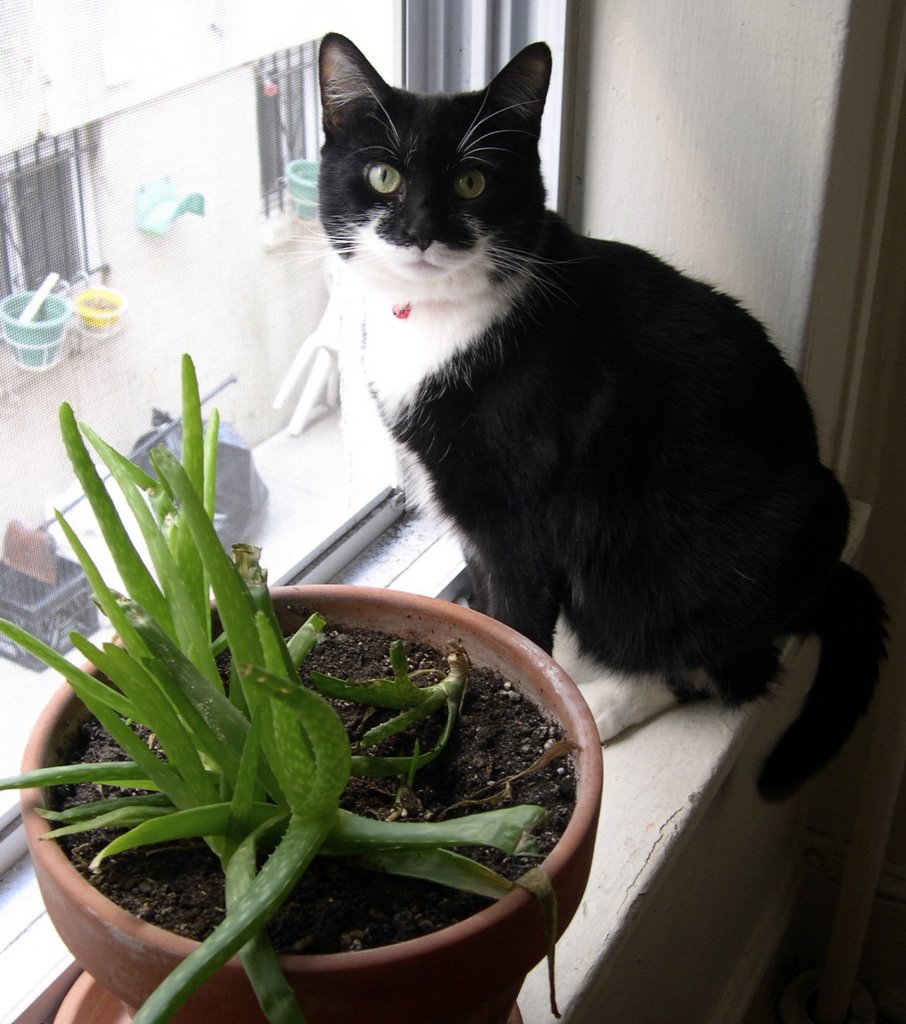
In the non-food world of WCB, Eat Stuff is with us again. Last week Whiskey terrorized the nation. Today, we find sister Kitty BoJangles, avoiding the chaos in her favorite sunny window… caught red-handed eating my Aloe plant!

Sunday, February 19, 2006

Citrus Salad


Vitamin C is vital to staying healthy in flu season. This simple powerhouse rears its head in numerous supplements. Today, one is able to uncover vitamin C enhanced dairy and cereal products. New beverages proclaim to be “C Monster” or “Ex-C-lent.” But like most things, it is always more satisfying in the natural state.

With Chinese New Year having just past, oranges are on the mind. Thought to have originated in the orient, it is no surprise that numerous Asian dishes contain oranges in some form. It is also no surprise then that citrus translates as “wealth” and “luck” from the Chinese, which is why it is eaten in the New Year—to bring us wealth and luck. I prefer this tradition to black-eyed peas and cabbage.

At a recent dinner party a New Orleans native claimed Louisiana oranges the best in the world. Having always thought Florida, perhaps Valencia, to be top pick, I did not even know Louisiana grew oranges. I took him up on the challenge. From the kitchen he withdrew a fresh-picked orange from a recent trip home. The result? It was excellent: sweet and juicy as an orange should be. Now if he will just bring a bushel back for me…

I recently read a short comparison on blood oranges. In sight and taste tests, the California blood won over the Valencia. So with blood oranges on my mind, I sojourned to the grocery store for the pickings. I returned with two blood oranges and broke into one on my walk home. Once that outer skin was cracked and peel discarded, memory assaulted me: I was sitting in my junior high school cafeteria eating blood orange wedges from my packed lunch. Kids made fun of me and my bloody fruit, saying it was disgusting. I simply ate my crimson fruit, happy that I did not have to share, happy with my gourmet mom, happy with all things good and sweet.

In an effort to curb a recent bout of gluttony, I am making more salads in the upcoming weeks. When I was single, salads were a staple. Not so much because they are healthy, but fast and easy. The most effort put into this one is peeling the fruit. (One could also just slice off the peel to save time.) It can even pass as a dessert. This salad is simple, delicious, refreshing, and a little bit different. A culinary amateur can easily prepare this with rave reviews. And do not pass up the salt-- it is a fabulous companion to the citrus.

CITRUS SALAD
Serves 2. Prep Time= 8 minutes.
* 1 grapefruit (white or pink)
* 1 orange
* 1 blood orange
* juice of 1 lime
* 4 slices fresh prociutto
* 8-10 fresh mint leaves, chopped
* sprinkle of coarse pink sea salt (Lot’s Wyfe pink Hawaiian sea salt is recommended)

1) Peel citrus, and slice into ¼-inch discs; arrange on 2 plates. Over each plate, drizzle the lime juice and sprinkle with mint. Lay 2 slices of prociutto on each plate. Sprinkle generously with sea salt and enjoy.

Monday, January 30, 2006

Loose Ends Lentil Soup


Soups are an all too easy favorite of mine: they are inexpensive; require little prep; are hearty and healthy; involve few ingredients to make delicious; are easy to alter with a little cream or blender; and are a fabulous way to clean out the refrigerator/ cabinets before a grocery spree. They are a leftover-lover’s dream: make them in large batches and freeze in single-size servings easily to transport to work for a no-think lunch your co-workers will drool over; perfect with some fresh bread.

Once the basics of making a soup stock are understood, whether it is meat or vegetable, there is no limit to one’s soup making abilities: A little less of that here, more of this there, and voilà, a new creation with little effort.

Growing up, a favorite household food was turkey. A golden-roasted turkey my mother would prepare in the late afternoon and have ready for us kids upon our arrival home from school. Friends would join us and we would pass through the door attempting to guess what mom had made. The favorite of mine was always turkey because it meant a whole week of fresh turkey sandwiches. It meant warm turkey with smooth, buttery mashed potatoes. It eventually meant my all-time favorite: soup.

It is from my mother (and of course my grandmother) that I have come to understand the importance of a flavorful soup base. I rarely order soup at a restaurant because I am always terrified of soup stock low in flavor (not enough bones or vegetables as a base) or too salty (covering up for the tastelessness of low flavor).

The Stock:
Although it may seem overly thrifty at the time, you will be delighted with yourself (and your soup creations) if you keep leftover “broth” from vegetables: Boil some beats or potatoes, steam some artichokes, but whatever you do don’t throw that leftover water down the drain—freeze it! That water, no longer clear, but deep crimson, pale green or white, serves as a flavorful addition to your soups (and is full of vitamins). Instead of water, use this as the liquid addition to your soups and you will no longer need bouillon to flavor your base. If you desire a vegetable stock, sauté some onions, leeks, celery, carrots, potatoes, etc. then add the leftover vegetable juice. (A friend of mine has said she cannot stand onion in her soup, a shame because I think this is one of the best stock basics. If you fall into this dilemma I have found extra celery can add a lot of flavor.)

The Meat & Bones of the Situation:
Much of the flavor received in soup broth is derived from bones, more precisely, the marrow-- not the meat (though the meat is a tasty treat). Whether it is chicken, beef, pork or fish stock you seek, the bones are where it’s at. The essence received from marrow that comes into soup is full of flavor, protein and mono-saturated fats (the good stuff that decreases bad cholesterol levels and is thought to lower the chances of certain cancers). Using bones in your soup also produces a rich, thick broth. (Bonus: The butcher or fish market often sells miscellaneous soup stock for cheap.) The great part about using bones with meat on it is that it makes for easy cleaning: the soup is done when the meat falls right off the bone.

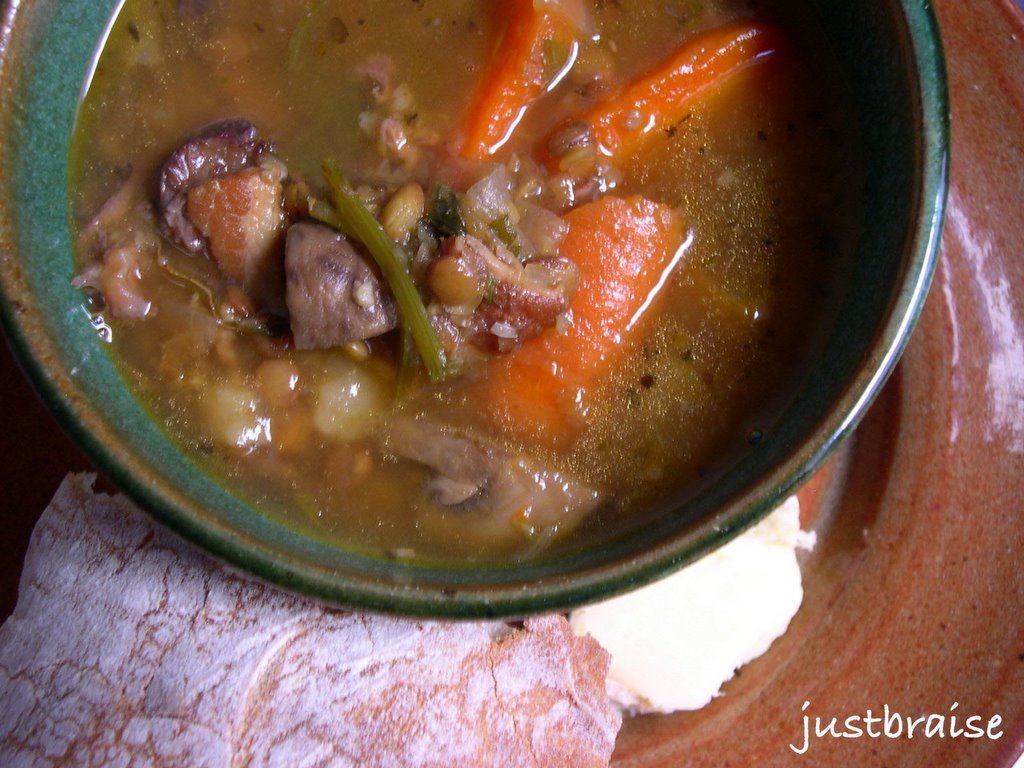
For this lentil soup, I cleared out everything that was left in my refrigerator and freezer: leftover oxtail bones, a few strips of bacon, some crimini mushrooms, ½ an onion, a few celery stalks, some carrots, 1 potato, dried lentils, 6 cups of frozen beet juice, 4 cups frozen artichoke-potato juice. The final result was excellent: Super hearty and loaded with flavor. You do not have to clear out your refrigerator, but do make this soup.

The picture is taken after about 1 hour on the stovetop (dried lentils were used, canned lentils will cut down cook time). Another hour later and this soup became thick and delightful: the lentils broke down into a light paste. This soup makes a fabulous meal with a fresh chunk of bread and a bite of sharp cheddar. The chunks of vegetables are full of flavor and the broth is so rich it is a taste from the fountain of youth. Dip your ladle, savor the goodness….

LOOSE ENDS LENTIL SOUP
Makes 8 servings. Prep time= 20 minutes. Cook time= 30 minutes- 2 hours (depending on canned or dried lentils)
* left over beef bones (or beef stock) (about 2 lbs, but whatever you have left is good)
* 5-8 strips of bacon (optional)
* ½- 1 lb crimini mushrooms, quartered
* 1 yellow onion, chopped
* 4 cloves garlic
* 3 stalks of celery, cut into 1-inch pieces. Retain leaves and add to the soup
* 3 carrots, cut into 1-inch pieces. Retain leaves and add to soup
* 2 russet potatoes, cut into 1-inch chunks
* 8-10 cups leftover vegetable “broth” or water
* 1- 5oz can tomato paste
* 2 cups lentils, washed and bad ones discarded
* 3 bay leaves
* 1 Tbl dried oregano
* 1 Tbl dried tarragon
* 5 Tbl hot sauce (optional for an extra kick)

1) In a large soup pot on medium-high heat, brown the bacon. Using a paper towel, pick up some of the fat (retail about 1 Tbl in the pot). Remove the bacon and set aside. Turn heat to medium. Add mushrooms, onion, garlic, celery (plus leaves), carrots (plus leaves), and potato into the pot with the bacon fat. Saute until onion begins to soften, 8-10 minutes. While the vegetables are cooking, slice the bacon into bite-size pieces. Return to pot.
2) Add bones, tomato paste, and vegetable broth (or water), bring to a boil. Add lentils, oregano, tarragon and hot sauce. Cover and allow to simmer (turn heat down if the soup continues to boil). If using canned lentils, cook time is about 30 minutes. If using dried lentils, cook time will be about 45 minutes- 1 hour. The longer the soup is left cooking the more the lentils will break down—cook this longer if a thicker soup is desired.


An interesting bone bite: Archeologists can determine how wealthy a civilization was (relatively) by looking at the bone byproducts. If bones were used as a source of food (cracking bones open and eating the marrow), it is likely meat was not plentiful or a famine occurred. Civilizations rich with food would discard animal byproducts (or use them as weapons or tools).

PS- Happy Birthday to me!.... and Jennifer.

Wednesday, January 18, 2006

Mushroom Celery Root & Leek Soup


When I spent a semester in Prague, I was jealous of a girl in my program who went to the woods with a Czech family to pick mushrooms. How was I not informed of this journey?! I had a fabulous cliché vision of a Mucha maiden, basket in hand, bonnet in hair, foraging around mossy logs. I attempted to steal away one weekend myself, but was warned of the dangers of picking harmless looking poisons. I remained in the city sulking.

A few years later I met up with family in Latvia. The days were full of sightseeing in and around Riga and visits to the countryside to meet assorted relatives. Nights were another story… Attempting to hold my own against Baltic blood, I confronted 2 straight weeks of vodka soaked nights. I would awake mid-morning to find bottles from the night before stacked by the door. My uncle laughed as he told me the golden rule if invited to a dinner party: one bottle of vodka per person will be consumed, plus one for the hosts to save. I was proud my college days kept me going as long as they did. By the start of the second week I was tired of drinking. “Stacite, no drink?” “NO! Done. No more.” I would go to the bathroom and return to find my juice spiked. One of those hazy mornings my uncle shook me: “I’m going to pick mushrooms, want to come?”

Yes! I want to go! But you fill me with so much vodka, challenging my heritage I cannot move!

So he left, without me, and returned hours later with a full garbage bag size of mushrooms. Fresh—from the market—not the forest. I may still have my chance yet.

I love mushrooms earthy meaty flavor. Raw, buttery, caramelized, fried or in soup, they are a perfect addition to countless feasts. This soup is great because it uses so few ingredients. I took the brain-like ball that is celery root, added my all-time favorite flavor enhancer the leek, and tossed in the protein savory goodness of cremini mushrooms. Cremini mushrooms are also known as brown mushrooms, they are a bit more flavorful than the standard white button mushroom. Once blended, the result is a delicious thick soup with chunks of mushroom. Add cream and it turns into a creamy treat.

MUSHROOM CELERY ROOT & LEEK SOUP
Makes 6 servings. Prep time= 30 minutes. Cook time= 40 minutes
* 1 lb cremini mushrooms, quartered
* 3 leeks, cleaned well and chopped
* 2 celery roots, skinned and cut into 8 chunks (celery root has the consistency of a potato with a salty celery-like edge)
* 1 medium onion, chopped
* 2 stalks celery, chopped
* 4-6 cloves garlic, chopped
* 4 Tbl butter
* 6 cups water (or leftover vegetable juices. Yes, I save vegetable juices)

1) In a large pot, melt the butter over medium heat. Add the mushrooms and allow to cook down, 10-15 minutes, stir occasionally. (While mushrooms are cooking, slice the other vegetables.)
2) Remove half the mushrooms and set aside. Add leeks, onion, celery, garlic. Sauté until limp, about 8 minutes. Add celery root and water (or vegetable juice). Cover, bring to a boil, reduce heat. Simmer until celery roots are soft when poked with a fork (about 30 minutes).
3) Once celery roots are soft, blend the soup. Use a handheld blender (highly recommended) or in batches with a stationary blender. Dish into bowls, pour in 1-2 Tbl of cream or milk, sprinkle with mushrooms that were set aside. Flavor with salt/ pepper to taste.

Friday, January 06, 2006

Tri-Bean & Beef Chili


My first and second grade teacher was a fabulous mentor for all things culinary. Mrs. G must have been an amazing cook and she encouraged our little hands at the same. At one point, we must have been learning about bivalves. Something very basic I am sure (there is only so much bivalve information a first grader can pick up). Later that day, we had 3 large batches of mussels steaming in the back of the class, “see how they open when they are ready to eat!” Mrs. G exclaimed. During the lesson, I can remember thinking why would anyone want to eat a “muscle”?! I could not imagine the muscles in my body resembling these hard-shelled critters and I was slightly repulsed by these midnight blue orbs cooking away at the back of the class.

A few minutes later, everyone was served up a small plate of mussels. I cannot imagine that I ate mine. Now that I think about it, this lesson must have done the teachers’ lounge much more good, because I am sure that is where the bulk of the mussels ended up. If I was in that classroom now, I would steal all mussels from all those grubby little hands, devouring them in great triumph. I would later marvel at how strong my own muscles were to steal such a quantity away!

The following year, second grade, still with Mrs. G, my elementary school hosted an all-school event. Every classroom chose a booth to host: Some made popcorn, some spun cotton candy, others ran a musical-pie-chair (the winner won a home-baked pie). Mrs. G signed us up for the chili booth. (I wonder if we were consulted on this because for a second grader the other booths sound much more appealing.) Mrs. G came to class one day and told us we were making chili. Mrs. G told us she was an award-winning chili chef, and we would be making her secret chili recipe. (I guess secret chili recipe sounds good enough for a second grader.)

Sure enough, event day was approaching. Some facts to know before we proceed:
1) There were about 500 students in my elementary school.
2) The event was held on the weekend so parents could attend and therefore, help raise money.
3) This equals about 1,500 heads to feed (figuring on some families only 1 parent will show, or there are multiple children + the staff)
4) My class had maybe 25 students in it.
5) A classroom full of second and third graders were to make chili for say, 1,000 people (my school had a 1-2 then a 2-3 grade split which is how I had Mrs. G for 1st and then 2nd grade)

So as event day approached our classroom was full of green peppers, onions, beans, tomato sauce and other assorted secret ingredients, enough to feed 1,000 people. I was lucky enough to be a green pepper chopper. I now feel sorry for any student that was given onion duty. Each of us were handed 5-10 of each vegetable and proceeded to chop. The last thing I remember of this process was a field of greenery covering my desk. The following day my classroom worked in shifts of 2 or 3 serving up cupfuls of chili to hungry event-goers, “That’s right! I made it!”

Last I heard Mrs. G was around the San Francisco area working as a principal in an elementary school. While visiting relatives in the area in 5th grade, my mother and I took a detour to Mrs. G’s new home. I remember groves of avocado, lemon and orange trees as we drank tea and reminisced.

Today’s chili is in honor of Mrs. G. I cannot remember any of her secret ingredients, but I still think it is pretty darn good. I was a vegetarian for six years and one think I take away from that is filling my chili with extra beans. A more colorful chili, this one is made with three different beans. I also tried something new, and threw in some hot Italian sausage, in addition to the standard ground chuck-- an excellent spice surprise. Next time I might add a third meat or other sausage variety (like chorizo). Do not be overwhelmed by the long list below. Many of these are items you may already have at home (or different varieties of the same food).

3-BEAN & MEAT CHILI
Use a 16-quart pot. Makes 12 servings (enough to freeze for future lunches). Prep time= 30 min. Cook time= 3+ hours (less if you used canned, not dried beans)
4 Tbl olive oil
6 garlic cloves, crushed
1 green pepper, cubed
1 yellow pepper, cubed
1 large onion, cubed
4 large links hot Italian sausage, removed from casings
1 lb ground chuck
10 sun-dried tomatoes, sliced (optional)
12-15 jalepeño peppers, sliced (optional)
1- 28 oz can tomato puree (no salt added)
1- 28 oz can diced tomatoes (no salt added)
2- 8 oz cans tomato sauce (no salt added)
1-½ cups red kidney beans, dry**
1-½ cups black beans, dry
1-½ cups white beans, dry
1- 28 oz can water (if you use canned beans this is not necessary)
2 Tbl Worchester sauce
2-3 Tbl Tabasco sauce
5 Tbl chili powder
3 Tbl cumin
2 Tbl oregano
1 Tbl cinnamon
4 bay leaves

1) In a 16-quart pot, over medium heat, warm the olive oil. Once warm, add the first 8 ingredients (garlic, (2) peppers, onion, sausage, meat, sun-dried tomatoes, jalepeño peppers). Stir occasionally, and allow meats to fully brown, about 15 minutes.
2) Add remaining ingredients, stir and cover leaving the lid slightly cracked. Bring to a boil then turn heat to medium-low. Simmer until beans are soft (about 3 hours), stirring occasionally. Add more chili pepper/ cumin to taste.

NOTE: 1) I try to buy tomato sauces with no salt added and then add my own salt. If I cannot find any no salt added cans, I will dismiss my own salt addition. 2) You can mix and match any form of tomato product you like for the base sauce. I like diced tomatoes because they add a nice texture. 3) **If you use canned beans cooking time is only about 30 minutes. I like the dried because I can throw this on the stove and forget about it while the smell fills the house.

OTHER OPTIONS: 1) Try roasting some red peppers and/ or tomatoes and add to the chili (roast a red pepper by placing it directly over flame. This is messing since some juices will drip. Once totally charred, place in paper bag to cool. Peel off blackened skin, chop and add to chili). 2) Use more sun-dried tomatoes. 3) Add brown sugar, honey, unsweetened, or very little semi-sweet chocolate to the batch. 4) Try other meats. I’m trying a second sausage next time. Bacon might do well too. Veal or shredded pork are other options. 5) Shrimp might do well in the above recipe, though it might create more of a gumbo flavor. 6) Add a can of beer or 2 cups red wine

Thursday, December 08, 2005

Kumquat Glazed Pork w/ Artichokes


One great benefit of the fall is the bounty served up. By no means comparable to summer, but I must admit that some of my favorite fruits are in season this time of year: pomegranates and assorted oranges (oh Clementine!) to name two. Mother Nature outsmarts the best of us when she decides to make citrus, pumped up the vitamin C, in season as cold and flu weather hits full force. To make that which is available so sweet, juicy and appealing makes this frigid weather worth leaving the home for (if only to go to the grocer to get some).

Those at work joke about my clementine pyramid stacked high on my desk, quickly eaten through and replenished. But have I been sick yet this year? Nay. Do I have scurvy? Nay. And I owe it all to a very sweet addiction: citrus.

On a recent visit to one of my previously mentioned 24-hour fruit/ veggie stands, kumquats stared me down. Originally from China, this mini-orange, translated as gold orange from the Chinese, is the best of treats. In my younger days, I could not get enough Sour Patch Kids, the tart, sweet, succulent gummy candy. Kumquats are the adult version. Pucker your lips and be brought back to those sticky movie theater floor days when you easily went through an oversized bag of candy before the trailers ended.

Though this gold orange looks a lot like an orange, the kumquat was removed from the genus Citrus around 1915 and moved into Fortunella. The fruit began cultivation in Europe and the U.S. in the mid-19th century. The kumquat is high in fiber and vitamins A and C. Replace your grandmother’s prunes with this tart treat. The skin is thin, mildly tart, but sweet enough to eat. The seeds are unnoticeable, and the overall affect is, as stated, the best of treats. Just wash, pop and chew. When cooked up, the fruit loses the sweet-sour tinge transforming into pure sweetness. This fruit is great as chutney, preserves, raw in salads, as a garnish (in a martini even), ornamental, or, in my case, as a sweet glaze for some roasted pork.

KUMQUAT GLAZED PORK W/ ARTICHOKES
Serves 4-6. Prep time= 20 min. Cook time depends on the size of the pork (as does serving size)
½ cup kumquats
1 clementine, juice only (or ¼ cup orange juice)
2 shallots, whites only, chopped
1 bay leaf
½ cup dry white wine
1 artichoke per person
4 lb boneless pork center cut (a pork shoulder works cell too)


The Glaze
1) Combine kumquats and orange juice, purée to a medium pulp
2) (Preheat oven to 350F in prep for the pork.) In a saucepan, on medium heat, melt 1 Tbl butter. Add shallots, sauté for 5 min.
3) Reduce heat, add bay leaf and kumquat mixture, bring to a boil. Add wine and return to a boil. Reduce glaze until desired thickness is reached (5-10 min).


Preparation of the Pork
1) Preheat oven (as noted above) to 350F. Use half the kumquat glaze and cover both sides of the pork. Insert meat thermometer. Place on non-reactive baking dish. And put on the middle rack in the over. Pork should cook 15-20 min per lb, until it reaches 170F.
2) After 1 hour, check on pork and cover with remaining glaze.


Artichokes
1) When pork reaches about 140F, boil water in a saucepot. Clean the artichoke under water and pluck any darkened outter leafs off. Cut off the stem so about 1 inch remains. Add artichokes and cook about 45 min until stem is soft. Artichokes are in season now. They are so meaty and perfect this time of year there is no need for butter or a goat cheese sauce (which, actually, makes a fabulous dipper and really impresses a party).

Wednesday, December 07, 2005

Sweet Sauerkraut

*Just Braise has moved. Please visit me at www.justbraise.com!*

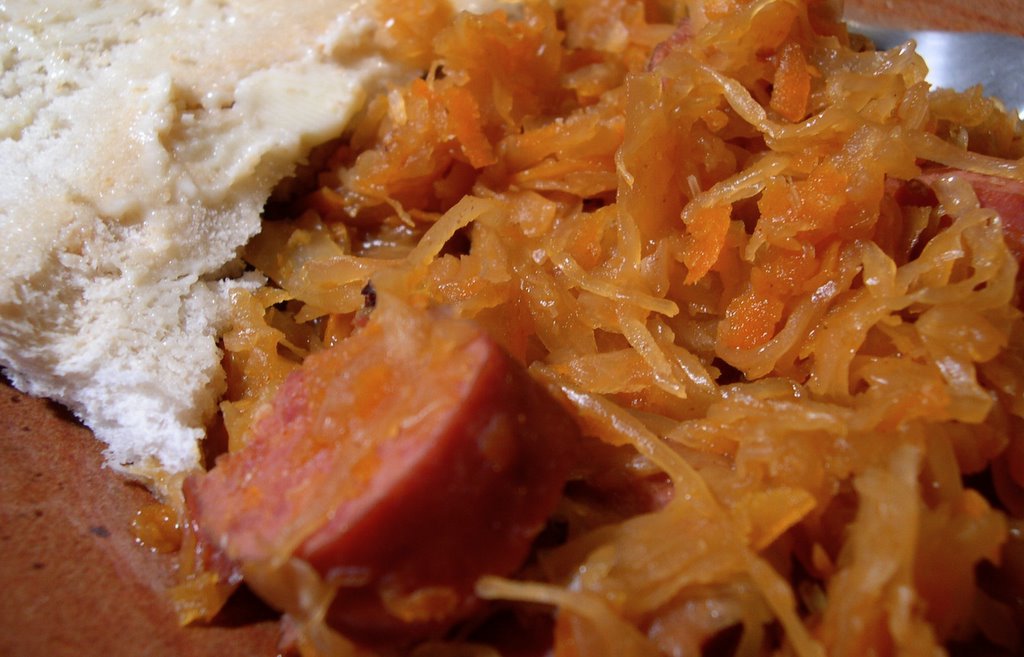
This is really a "sweet"kraut and not sauer- or "sour"kraut because in the end, that is what it is: sweet. It is not the traditional sauerkraut that many think of-- the kind that comes piled high on hot dogs, a classic Chicago topping-- or on the side of a plate at a BBQ. This is Sweet Latvian Sauerkraut.

This is a 'kraut that is spiked with brown sugar and slow cooked with fruit and vegetables so the natural sugars escape in the cooking. It is the kind of 'kraut that even if the bag or jar you extrude it from states "ready-to-eat" or “warm and serve” you dare not sit and eat it until it has been subjected to your love for a good few hours.

This is the kind of 'kraut that stinks up your whole house for days (and eventually your mother will move the cooking process to a portable stovetop in the garage, leaving you craving the smell that usually accompanies the dish). When you are younger still, you will think this dish to be a little too bitter, but you know you must love it, and will always force a little down your throat because it is the dish that your grandmother makes for every family meal, no matter the season. It is a dish that is soul warming, and smells like home. It is the dish your boyfriend will take to work, and when reheated, he will have people salivating around him, begging for a bite, praying for the recipe.

The recipe below is made with kielbasa. It is also a sweet accompaniment to my grandma’s perfect Latvian Pancake. It can be eaten on hotdogs, or hamburgers (in place of carmelized onions possibly). Or, in the preferred method of many in my family: slathered on top of real, good, Latvian bread (or the next best substitute). It is also good with a cold beer.

SWEET LATVIAN SAUERKRAUT
Serves 4. Prep time= 30 min. Cook time= at least 2 hours.
1- 32 oz bag sauerkraut (or equivalent jar)
2 medium-sized carrots, shredded
1 apple or pear (sweet and juicy apple or slightly sour: from fuji to grannysmith), chopped
1 medium white onion, chopped
3 Tbl brown sugar
1 Tbl paprika
½ cup apple cider, apple juice, or beer
1 package (2 12-inch) kielbasa (I used turkey kielbasa for this one)

1) Turn on the broiler and begin to warm a saucepot on the stovetop, medium heat.
2) Put the kielbasa on a pan with juices. Slice down the center. Broil about 10 min or until the top opens, juices bubble, and the skin darkens.
3) While kielbasa is cooking, add 1 Tbl butter to the saucepot. Add onions and sauté 5 min. Add carrots and apple. Sauté 10 min. (Remove kielbasa from oven while this is warming.) Add sauerkraut, brown sugar, paprika. Stir well.
4) Cut kielbasa into bite-sized pieces. Add to pot, stir. Turn heat to medium-low, leave slightly uncovered, allow to cook at least 2 hours. The longer you can stand, the better, allowing the aroma fill the home. Stir periodically. Serve with true hearty and flavorful rye or pumperknickle bread, preferably from Latvia, buttered and toasted.
Note: If you will be cooking this more than two hours, check at least 1 time every half hour. Add more juice if 'kraut appears too dry.
NOTE: I have received many an angry phone call from uncles and grandma: "Where is the caraway???" Well, I don't really like caraway in my sauerkraut. But you may add 1-1/2-2 Tbl to your dish.

Sunday, December 04, 2005

BBQ Pork Short Ribs w/ Green Beans & Sweet Potato Fries


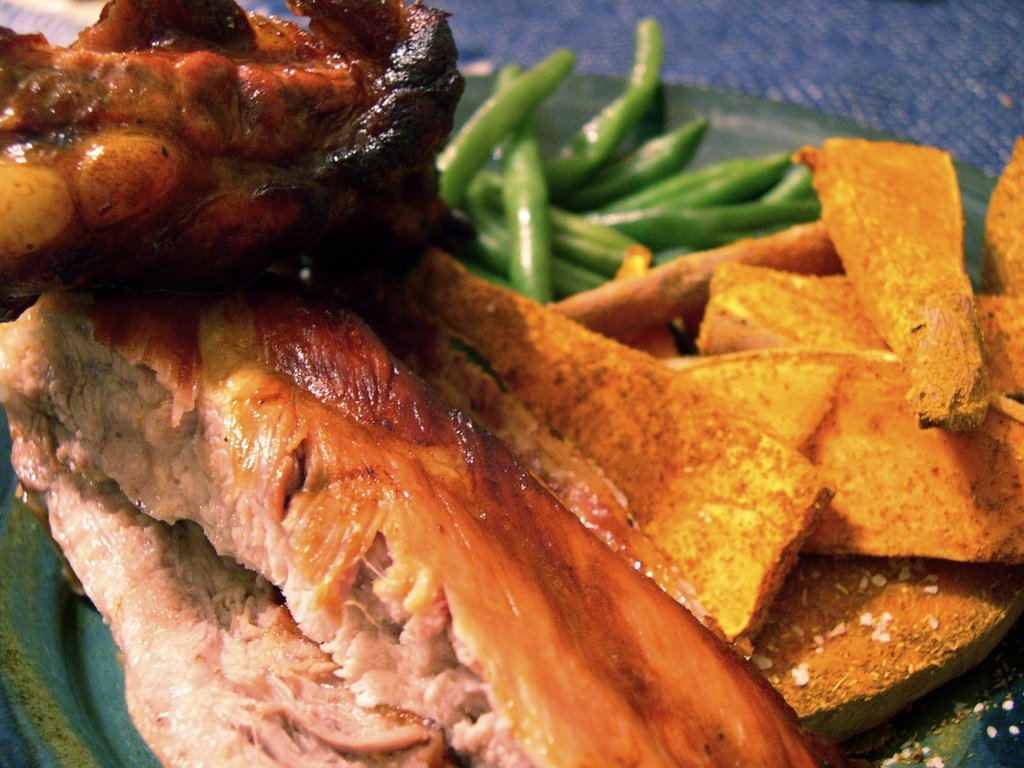
I love ribs. Actually, I love almost any typically southern cooking. When I was younger, I can only remember having ribs when we went to our family’s favorite restaurant, New China. As I grew older, I realized how delicious BBQ ribs could be in other (non-Chinese appetizer) forms. When my mother comes to NY for a visit, I always make sure to lead her to Blue Smoke, a great rib joint, but a little expensive for my everyday budget. When I first started dating D, he too felt the southern pull, more so than I, being from the south himself. At the time, he lived across the street from Soul Spot in Brooklyn. If you live nearby I highly suggest a visit. Their oxtail falls right off the bone and their jerk chicken is spicy and delicious—and even better, their portions are gluttonous for the price. Interestingly enough, the owners are from The Gambia. Who would have thought these men could nail the craving that many of us have for southern home cooking? Today, I was not craving BBQ ribs until I could smell them cooking…

Sometimes I have to bribe D to come to the store with me. This is when I know I want to buy too many things I can carry home alone. Usually, it’s something along the lines of, “If you come to the store, I’ll let you pick out some meat”. If I’m left to my own pickings, I’ll go for a quick and hearty beet salad-- and I know D cannot resist picking through whatever looks fresh in the meat department. Today it was pork short ribs. We have no grill and cooked them in the oven, doing a quick par-boil according to the Joy of Cooking. I finished off the meal with some steamed green beans and baked sweet potato fries. Our friend DR was over. Even though he had his own pork chops to go home to, he too could not resist trying some ribs (and our cats could not keep off the table).

PORK SHORT RIBS W/ GREEN BEANS & SWEET POTATO FRIES
Serves 2. Prep + Cook time= 1 hr 30 min
2 lb pork short ribs
4 Tbl BBQ sauce
2 sweet potatoes
handful of green beans

1) Preheat oven to 450F. On the stovetop, in a large pot, boil water. Add ribs to water and boil 2-3 min. Remove and place in baking dish. Place on middle rack in the oven for 15 min.
2) After 15 min, remove from oven, apply BBQ sauce and reduce heat to 350F. Bake for 1 hour more, basting frequently.
3) While the ribs are cooking, prepare sweet potato french fries according to previous recipe here(they require 30 min cook time and can be cooked with the pork on the next lower rack in the oven).
4) When 5 min remain on the baking, prepare green beans: In a medium saucepan, place 4 Tbl water over medium heat on the stovetop. Snip off ends and wash green beans. Add beans to pan and allow to simmer about 3 min. Remove from heat and drain any remaining water. Add a small tab of butter and mix into the beans until melted. Dish onto plates along with finished potatoes and ribs.

Friday, November 11, 2005

Pork Chops stuffed w/ Chorizo and side of Broccoli Rabe

On a recent celebratory dinner, D, C and I went to Angus. A slightly hidden treasure in Times Square, it is an oasis in the swarms of tourists. It is where you can overhear producers discuss their upcoming musical, where you can find the washed-up actor enjoying a dinner alone at the bar, and where every meal will be perfectly served to you, possibly by the next Broadway star with a hint of attitude. Every morsel I have had there is superb-- from brunch through desserts. They know how to make a martini, as well as provide an ample mini-carafe of wine when ordered.


So with a musically inclined item to celebrate, I was escorted by two men to a cozy table on the first floor near the wall of windows, overlooking the "Phantom" marquee. Working through the day, we had neglected food, so this was also a celebration to break the fast. I ordered the small appetizer-size of mussels in a white wine cream sauce with bacon and peas, a side of frites and a pino grigio. Both men ordered the pork, stuffed with chorizo and a side of broccoli rabe.

The mussels were rich and luxurious. I plucked each mussel from its home, using an empty shell and scooped up the sauce. I dipped the frites into the sauce to sop it up, but still, the cream won and I collapsed, full, exhausted and licking the last of it off my fingers. It did not go to waste. After C had finished his pork, he grabbed the last of mine, leaving the bowl crystal clean and without need for washing. (If you know C, this is very much out of the ordinary.) D finished his portion as well, and enjoyed it so thoroughly that the southern boy in him craved it like a pregnant woman needing pickles tonight. And even though our refrigerator broke yesterday and we would not receive a replacement until tomorrow, D went out to the nearby grocery for the rabe, the Spanish deli for the chorizo, and we removed the thawing pork (purchased a few months back from Costco) for a delicious imitation of the original. Another meal I would soon collapse from, full, exhausted and licking my fingers.

Once the ingredients are purchased, the meal is quite simple to make, requires few ingredients, and takes at most 30 min (depending on the thickness of your pork). To be served with an ice cold glass of Jack and Coke.
Serving size: 2
2 pork chops (at least 1.5 inch thick)
2 chorizo links [chorizo is a Mexican sausage and should not be replaced with any American or Italian sausage. It is spicy and sweet and has a unique texture)
1 bushel broccoli rabe
1 small white onion
2 cloves garlic
salt/ pepper to taste
butter

1) With a sharp knife, slit the pork chops along the edge, about 3/4 of the way through so you can later stuff it with the chorizo. Grind fresh pepper on each side to taste.
2) On a hot skillet, sear the pork chops. Use hot heat initially on both sides, then reduce the heat to allow cooking through. The idea is that searing keeps the juices in and the low heat slowly cooks the inside.
3) While this is cooking, slice the onion and place in a small, warm skillet for 5 min. Cut the ends off the chorizo links and push the meat out of the casing, into the skillet. Allow to cook about 10 min, stirring to ensure even cooking.
4) While the chorizo is cooking, enjoy its' sweet smell and keep watch of the chops. It is important to cook pork all the way through. You want it to turn a white hue and lose all pink. Do not get overzealous and cook too quickly, this will dry the pork out.
5) When the pork is almost done, put an ample dab of butter into a pot. Once melted, add the broccoli rabe, cover, and allow to wilt, about 10 min add kosher salt to taste.
6) While the broccoli is cooking, the pork should be close to done. Stuff the pork with chorizo. Whatever cannot be stuffed inside, put on top and around in the skillet. Cover, and cook for about 5 min. The chorizo will begin to sizzle and begin to blacken.
7) Remove, serve and prepare to lick your fingers and be thoroughly satisfied.


View Stats
Rankingblogs.com: Defining your blogs worth..