


Saturday, February 18, 2006

Rum Raisin Oatmeal Cookies (+ WCB #37)


My father loves ice cream. He will not admit it, claiming he is too healthy to put such garbage in his mouth. When I was younger, my father used to purchase ice cream “for the kids;" Rum Raisin and Coffee. I do not know very many children whose favorite ice cream flavors are Rum Raisin or Coffee. Placing the pints in the freezer, talking more to himself than any of us, he would exclaim, “don’t eat too much or you’ll get stomach aches.” In the morning, the pints were gone.

Exploring these two ice cream flavors as a child has probably done worlds for my taste buds: On a family vacation in the Dominican Republic I happily participated in taste tests at a rum factory. I am sure the top destination choice for my 6 year old self was in fact, the rum factory. Mesmerized by the gilded thread hugging the bottles, I did not blink when we left the factory with more caseloads of rum than could be carried.

Over the years I developed a taste for Rum Raisin ice cream. The smooth vanilla bean base blended perfectly with the spicy kick of rum. When a recent cookie craving threatened an otherwise sweet-less week, a bout of inspiration came to pass: oatmeal raisin cookies, spiked with rum.

As the raisins soaked overnight in their rum bath, I plucked one out for a tasting and was brought back to the rum factory; back to the vanishing pints in the freezer. I adapted this recipe from the best oatmeal raisin cookie I know: the bottom of the Quaker Oats box. The changes, other than the rum-soaked raisins, include less butter, allspice, and the addition of rum extract for an extra kick. These cookies are thin and golden with crisp edges, keeping soft centers days later. The rum provides the perfect winter spice while the oats whisper at a meal.

RUM RAISIN OATMEAL COOKIES
Makes about 25 cookies. Prep Time= 10 minutes. Cook Time= 10-12 minutes.
* ¾ cup (1-½ sticks) butter, softened
* 1 cup firmly packed brown sugar
* ½ cup granulated sugar
* 2 eggs
* ½ tsp vanilla extract
* ½ tsp rum extract
* 1-½ cups all-purpose flour
* 1 tsp baking soda
* 1 tsp cinnamon
* 1 tsp allspice
* ½ tsp salt
* 3 cups Quaker Oats
* 1-½ cups raisins, soaked overnight in white rum

1) Soak raisins in white rum overnight.
2) Preheat oven to 350F. Beat together butter and sugars until creamy. Add eggs, vanilla and rum extract; beat well.
3) Add combined flour, baking soda, cinnamon, allspice, and salt; mix well. Stir in oats and raisins; mix well.
4) Drop by heaping tablespoonfuls onto ungreased cookie sheet, 2 inches apart. Bake 10-12 minutes or until golden brown. Cool 1 minute on cookie sheet; remove to wire rack.


And for the non-food related WCB #37 hosted by Clare at Eat Stuff. I bring you The Face Off:
Tuesday, February 14, 2006

Love Potion #14


In grade school, each child is more or less required to present everyone a Valentine’s card. Digging through the bought selections, a child picks their favorite for that special someone. As elementary school turns into middle school, it becomes all the more important to receive a Valentine. Children form cliques and get catty. More precisely, children begin to figure themselves out at this time; children can be cruel. Receiving Valentines equates how many friends a child is surrounded by.

We get older and Valentines becomes more or less special depending on if we are “with” someone; desperate to find someone before the day approaches to avoid being alone. What someone does for Valentine’s Day is equal to how much one is loved. It becomes a competition between couples: who has the more romantic lover?

A few years ago, my roommate and I, both single, sat down to make Valentine cards. With paper in varying degrees of pinks and reds, we cut, pasted, and bejeweled about 100 cards. We hit work, hiding them on peoples’ desks. We hit the bars, handing them to cute single patrons. Everyone who received a card thoroughly enjoyed them, posting them on their bulletin boards for months to come (some still have them posted). I think this means that we do not trade love enough as we age. Desperate for a show of friendship, we will hang on to postcards from anyone and everyone: we want to show off our friends. Or maybe I live in a city full of lonely people.

I am now “with” someone, but having grown cynical over the years being “without,” Valentine’s Day is really any other day—people just wear more red. Everyone is still looking for love. Whether it is found amongst friends, lovers, or in food, it is natural to search for comfort.

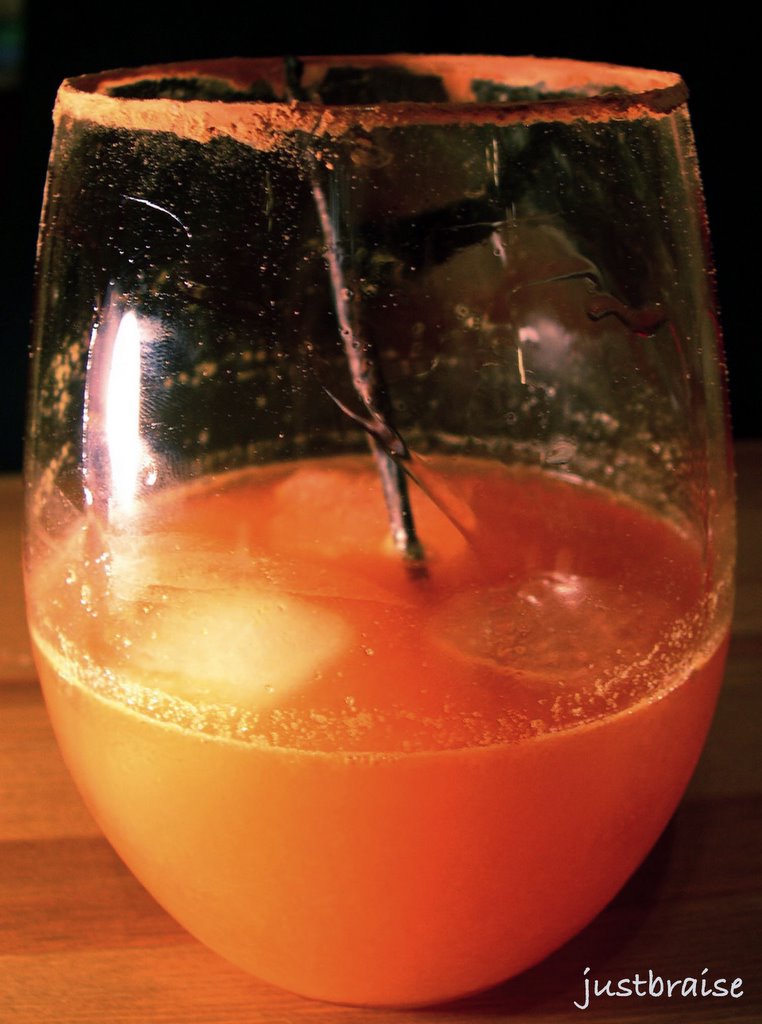
This is my Valentine to you dear reader. Enjoy this beverage at brunch as a sophisticated alternative to the classic mimosa. Present it at dinner for a winning combination. Alone, this beverage is the epitome of urban cosmopolitism.

LOVE POTION #14
Serving Size= adjust to quantity making. Prep Time= 5 minutes.
* cocoa powder
* 1 part blood orange juice
* 1 part champagne
* 1 part vanilla vodka (plain vodka is fine for something a little less sweet)
* 2 tsp pomegranate concentrate for each person
* garnish with vanilla bean

1) Place cocoa powder in a dish. Wet rim of glass with orange juice and dip the rim into the cocoa powder.
2) Fill glass with ice cubes. Pour in juice, champagne and vodka. Put the pomegranate concentrate on a spoon. With the spoon up to the inner edge of the glass, slowly release pomegranate concentrate around the inner glass, allowing it to coat the sides. Garnish with vanilla bean which also acts as a swizzle stick.

Monday, February 13, 2006

Frittata Up The River


There were few “food” days growing up that I enjoyed rising for. Weekday food treats meant my mother was appeasing one of the three kids about the upcoming school day: Would we be taken to the dentist after school? Did one of us have a test? This could all be gauged by the care put into the weekday breakfast: Chocolate chip pancakes are shots at a doctor’s annual. Cold cereal and orange juice is a regular day.

But oh, those fabulous Sundays! My brothers and I would be dragged kicking to Sunday school. One would complain of fever, one would hide in the closet. I always waited until I got into class. As the teacher began discussing King Solomon, I raised my hand: “I have to go to the bathroom.”
“Really, Stacey? The bathroom?”
“Yes, I have to go.”
“Fine. But come back this time!”
“Oh, yes, I will.”

I left class, walked past the bathroom, took a right at the lounge, made a beeline for the Sisterhood Gift Shop, entered the small glass cube, ducked behind the counter, and twisted 3 inch purple ribbon into bows for my mother, head shopkeeper. “What happened to class?”
“I had to go to the bathroom.”
I sat on the floor pulling bows for 45 minutes while my class was lectured about the King. Soon, the sound of footsteps echoed in the halls making their way to the congregation room. I found my class, sunk into the rhythm of their footsteps, and entered the room to sing for the next 20 minutes.

Song time ended and I returned to the gift shop. I helped my mother clean and lock up, my brothers would arrive, and we would meet my father at the local delicatessen. Within seconds our platter arrived. It was the same platter that we ordered every Sunday: 1 pound thinly sliced Nova smoked salmon, 2 slender glistening white fish, 1 scoop plain cream cheese, 1 scoop chive, sliced tomatoes, onions and a bucket of pickles. Each received a plate with their personal bagel: sesame for my father, everything for my mother, plain for my older brother, raisin for the younger, and egg for me-- all toasted or fresh according to taste.

Now, when I eat smoked salmon, I cannot help but remember those platters of fish for my family. Needless to say, I can appreciate smoked salmon in a variety of ways these days. It does not hurt to have a bagel with a schmear on the side, though. Smoked salmon is usually reserved for special occasions now-- a wee too decadent for weekly consumption.

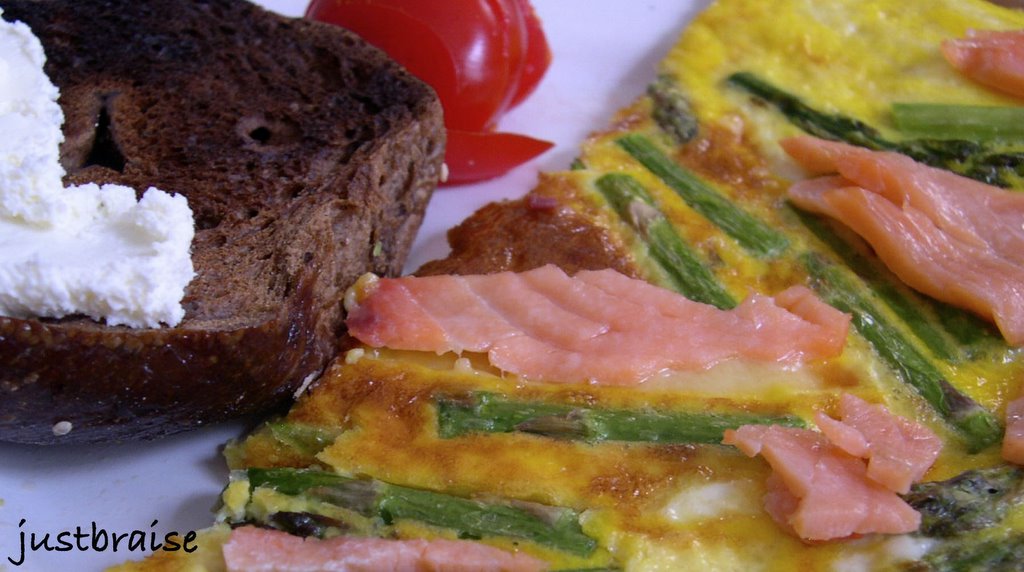
This Valentine’s Day, have a special meal. Better than going out is making something at home. It does not have to be overly expensive to be special, just good. Make your favorite meal with perfect care, if it’s for a special someone doing what you know will take the edge off. This frittata has two of my favorites: asparagus and smoked salmon (and a bagel with schmear on the side). So there you go, go up the river and bring back the memories—just leave King Solomon behind.

FRITTATA UP THE RIVER
Serving Size= 2. Prep + Cook Time= 15 minutes.
* 4 eggs
* 3 Tbl milk or cream
* 1 tsp pure vanilla extract
* 8 asparagus stalks, washed and cut into 1-inch pieces
* 4 slices (about ¼ pound) smoked salmon, cut into bite-size pieces
* 1 Tbl butter

1) In an oven-safe skillet on the stovetop over medium heat, warm pan and melt butter. While butter is warming, crack eggs into a bowl, add milk, vanilla and whisk together. When butter begins to bubble, sauté asparagus until a dark green, about 3 minutes. Add eggs over top, leave on heat for 3 minutes.
2) Turn broiler on. Place skillet under the broiler and bake 8-10 minutes. Eggs are done when they are set and lightly browned. Remove from broiler, place smoked salmon over top, return to broiler for no more than 20 seconds (you do not want to cook the salmon—it is already smoked—just warmed).
3) Serve with cream cheese schmeared toast or bagel.

Saturday, February 11, 2006

Baked Caramelized Pear (+ WCB 36)


There are two desserts of my youth I remember distinctly: baked caramelized fruit (pear or apple) and apple pie. The baked fruit was always my favorite. Overzealous trips to orchards in early fall would result in bins of apples stored in my family’s basement. As we got to the bottom of the bins, those sub par broken down apples became a sweet treat.

Unbeknownst to anyone else, my mother would rummage through the apples, plucking up bruised and downtrodden fruits. A sweet heavy haze of caramel would impregnate the house. Noses would turn skyward, tracking the smell like the expert scavengers my brothers and I were. Floating into the kitchen on the wings of our noses, we took our positions at the counter awaiting our prize.

Soon enough, my mother would pull the fruit from the oven. Sepia tinged, wilted from heat, and bubbling over the top, once perfect fruit was transformed into a superior delicacy. Forks injected prey and all was liked clean.

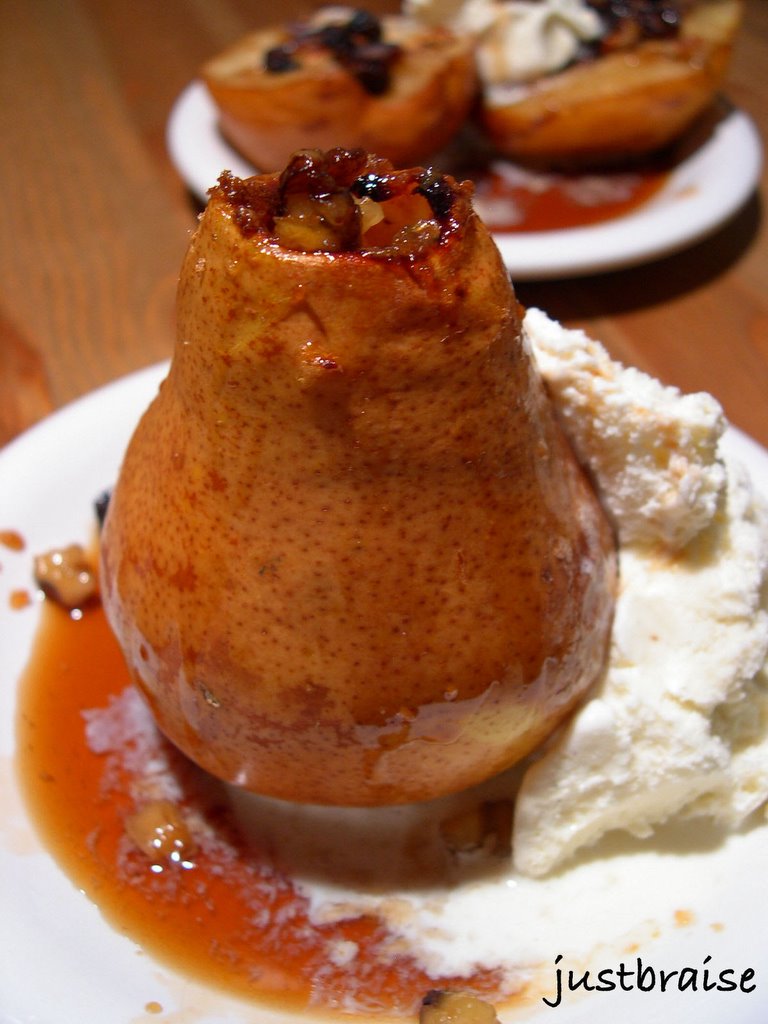
Baked caramelized fruit is one of the easiest desserts to prepare. Healthiness can be altered according to personal preference, altering the quantity of brown sugar used. With little effort and some quality oven time, one can turn past-prime fruit into a splendid dish to savor. With a scoop of vanilla ice cream this dessert is brilliant. At my local French restaurant a pear is soaked in red wine over night and called, “Poire Belle Helene.” At another restaurant, a banana is caramelized and served with a rich molten peanut butter cake (the same as the molten lava chocolate cake but with a peanut butter center). Here it is simple, quick and delicious. The wolves will be brought with trickery to the table, devouring their fruit in a gluttonous huff.

BAKED CARAMELIZED PEAR
Serving Size= 2. Prep time= 5 minutes. Bake Time= 35-45 minutes.
* 2 overripe pears, washed and cored
* 2 Tbl brown sugar
* 2 Tbl raisins, dark or yellow
* 2 Tbl walnuts, chopped

1) Preheat oven to 375F. Prepare pears and set on a baking dish. Stuff each pear with ½ Tbl brown sugar, ½ Tbl raisins, ½ Tbl walnuts, layering, then the other ½ Tbl brown sugar, raisins and walnuts (each pear receives 1 Tbl of all ingredients). Place in center of oven and bake uncovered 35-45 minutes. Pears should be golden, slightly wilted and soft.
2) Serve on plates with a scoop of ice cream. Pour released juices over top.


And... Non-food related Weekend Cat Blogging #36
Devilish Whiskey has a talent for waking me up in the morning while he goes on blinds patrol:

His sister's great talent you ask? Sleeping, of course:

Friday, February 10, 2006

The "Waldorf" Salad


I often use walnuts and dried cranberries (not sweetened Craisins) in my salads. It sweetens as well as breaks up the usual routine of tomato-carrot-celery. I once did this for my friend B from Egypt. I brought out the salad and to my delight B took a bite and was wowed: “How did you think to add the nuts with cranberries-- and pear?! This is amazing.” High on the powers of praise, I neglected to tell B that it is actually a fairly popular salad combination here in the States; I merely shrugged.

Much to my delight many a variety of the Waldorf salad is making its way onto menus across the country. Health conscious clientele are pushing the traditional mayonnaise-based dressing out of habit, calling for a more delicate covering, allowing natural tastes to break through.

The Waldorf salad’s namesake comes from the hotel it originated from: The Waldorf Astoria, in New York City. Created in 1886 by the maître d’hôtel, Oscar Tschirky, the original recipe calls for apples, celery and mayonnaise; it was later that walnuts were added to the mix. Since then, the salad has morphed into many variations.

I was recently taken to the famed Waldorf Astoria for a luncheon. The Waldorf salad was ordered out of respect for the establishment. The hotel now adds avocado to their salad, an excellent surprise. I unfortunately (or maybe happily) left that meal so stuffed I was in a food daze the remainder of the day. This meal was the catalyst to the birthday week of gluttony, ending with pants splitting along the leg seam. This incident will also cause me to take a more (somewhat) subdued and healthy approach to cooking this week, starting with this salad today.

There are too many modifications to suit specific tastes over the years that I will only say this: mix and match your favorite nuts, dried and fresh fruits, and lettuce bedding, and you will most likely produce a delicious, healthy salad. For my own, I usually stick with endive, pear and a tossing of good crumbly feta. Today I went without cheese and added radicchio (which resembles a small red cabbage with a slightly spicy taste). I also coated the salad liberally with Lot’s Wyfe New Zealand pink coral salt, and a sprinkle of Manicardi Balsamic Vinegar, my two new favorite kitchen additions. One can also make a light mustard-lemon juice-olive oil vinaigrette.

”WALDORF” SALAD
Serving Size= 2. Prep time= 5 minutes.
* 1 endive head, thinly sliced
* ½ radicchio head, thinly sliced
* ½ fennel bulb, thinly sliced
* 1 apple, thinly sliced (or pear)
* small handful of green beans, washed, trimmed and halved (optional; blanched or raw)
* ¼ cup dried cranberries (or other dried berry)
* ¼ cup chopped walnuts

1) Combine and mix the endive, radicchio, fennel, apple and green beans. Distribute onto 2 plates, sprinkle cranberries and walnuts on top. Drizzle with a good balsamic vinegar, or a homemade mustard-lemon based vinaigrette. Add salt/ fresh ground pepper to taste.
NOTE: Crumbled feta or blue cheese make excellent additions to this salad

Thursday, February 09, 2006

Braised Leeks in Cream


It is only recently that I have come to appreciate the subtle, sweet nature of leeks. In soups, they are bold enough on their own, or a perfect cover up for those who detest the onion. Leeks are a fabulous flavor enhancer to seafood dishes (perfect with broiled scallops). They are delicious in an omelet, over a salad, or slightly sautéed in a vegetable purée.

There is written evidence of leeks since the time of the pyramids. The Greeks once dipped leeks in their very precious oils before eating, thinking it did marvels for their singing voice. In present day Europe, the leek is jokingly known as “poor man’s asparagus”. I would have to say the earthy flavor of asparagus is far different than the subdued leek. To this day, the leek is the Welsh national emblem.

Related to the onion and garlic, leeks carry the same health-promoting qualities: reduction of LDL (“bad”) cholesterol while raising HDL (“good”) cholesterol; reduced risk to certain forms of cancer; and high in many vitamins, especially those that stabilize blood sugar levels.

Leeks are best late fall to early spring when they are in season, though they are available all year round. When buying leeks, look for ones on the smaller side. These offer a more sweet and full flavor. They should be firm, with a good portion of white stalk (in most dishes you will only use the white part). If stored in a plastic bag, leeks can last in the refrigerator for just over one week if stored untrimmed and unwashed. Once cooked, leeks will only retain freshness for about two days.

Make sure to wash leeks well. Usually grown in sandy soil, dirt can easily get into the inner rings of the leek. To wash, remove outer leaf and slice in half lengthwise. Under running water, use your fingers to wash between the layers, scrubbing any dirt that may cling.

I have wanted to make this recipe for a while. I go to the grocery, buy leeks, eventually making soup and end up throwing them in. When I had scallops in the house, I was going to braise the leeks, resting the scallops on a fresh, green bed. This would be an excellent pairing and suggest people try it. (Instead I went for horseradish spiked mashed potatoes, which was equally delicious). In this recipe, the cream and Parmesan cheese compliment the sweet leek perfectly, while the bread crumbs toast into a lovely crunch. Perfect standing on its own as accompaniment, this dish is terrific.

BRAISED LEEKS IN CREAM
Serving Size= 2. Prep time= 5 minutes. Cook time= 45 minutes.
* 4 leeks, halved. Trimmed of dark green leaves and washed.
* 2 cups milk or cream (I used milk because I had no cream. Cream would be excellent though)
* 1 cup vegetable stock
* 2 tsp thyme
* ½ cup Parmesan cheese, grated
* ½ cup bread crumbs

1) Preheat oven to 400F. After washing and trimming leeks, assemble halves layers up in a baking dish. Pour in the cream (or milk) and stock, sprinkle thyme over top. Bake uncovered on the center rack for 40 minutes.
2) Remove, sprinkle bread crumbs and Parmesan over the leeks. Return to oven and bake another 5 minutes, until bread crumbs are lightly golden. Remove and serve.

Monday, February 06, 2006

Strawberry-Banana Corn Mountain Pancakes


The door to a girl’s heart lies in a fluffy pancake. I do not take comfort in flabby, thin pancakes I have sometimes been served. Nor am I much a lover of the generic buttermilk pancake. Though good, I have grown tired of their monotony. Recently, I was served a wheat germ pancake larger than a Frisbee. I was more impressed by the size than the flavor. At this same meal, I was told my friend’s upcoming wedding will serve pancakes at the reception. From my favorite pancake spot I used to order 10 little dollar pancakes. Sometimes known as silver dollar pancakes, I enjoyed these because my tiny hands could cup a pancake, and easily be shoved whole onto my delicate palate. My grandmother makes pancakes without following a recipe, effortlessly puffy, requiring all grandchildren to drench them in her homemade jam. If another’s jam is brought to her kitchen she will “forget” to put it out amongst her own.

I have required D to make these pancakes for me often. They are his family’s “secret” recipe—taken from a cornmeal box long ago. They are the pancake of his youth and happily remembered breakfast table. The first time he made these pancakes for me he held the phone to his ear, mixing ingredients, as his mother retold the recipe she refused to write down. A few weeks later, he had called so often, the recipe was mailed to him.

The perfect fluffiness, the perfect denseness, the perfect sweetness, these pancakes are bold enough to stand on their own. One day, behind D’s back, I added chopped apples, mimicking my grandmother’s perfect pancake. When he turned around to witness the horror I had created he refused to proceed. Just go on, I encouraged. Before long he happily exclaimed the apple to be the perfect complement to the cornmeal and molasses base. Since then, D and I have made these pancakes in countless fruit forms: apple, pear, banana, blueberry, strawberry, peach...

We have also altered the original recipe slightly. Again to D’s horror, I emptied a jar of applesauce into the batter. You’ve ruined it, he moaned. Remember the apples, I pushed. When the pancakes were complete they were fluffier than ever. Since then, whenever applesauce is in the house, we happily add it, along with any fruit we may have.

D and I normally make a whole batch of these pancakes. Their subtle aroma fills the house and two or three days later we pop them cold into our mouth on the way out the door. We offer them to friends who are overly impressed with their not-so-simple looking nature. Little do they know how simple they really are.

The key to these pancakes is in the cornmeal and molasses. Only top-quality ingredients should be used. Last summer at the Indiana State Fair, D’s mother gifted us a bag of cornmeal from Sunny Slopes Farm. It is the perfect cornmeal for this pancake (they do not take online orders: 765.874.2170). A few months later when we ran out of cornmeal, I called Sunny Slopes. As I spoke to Mrs. Slope herself about the benefits of farm-fresh products I told her I would only buy direct from farms in the future. She laughed and sent me 2 lbs of cornmeal, complete with invoice. A few days later I kept my promise, ordering goat cheese I had fallen for from a farm outside of Poughkeepsie.

These pancakes are simple and delicious. Making them takes little effort. They are sure to become a household favorite. With this recipe, you may now discard all other pancake recipes (except for maybe the baked apple pancake). Play with the amount of molasses used. D and I actually use Sorghum, about double the asked for quantity. We also usually throw in fruit-- this is optional, but delicious. Do what you may, but never say these babies are dull, lacking flavor or fluff.

CORN MOUNTAIN PANCAKES
Makes about 15 4-inch pancakes. Prep time= 10 minutes.
* 1 egg
* 1-1/4 cup milk
* 5 Tbl vinegar
* 2 Tbl molasses
* 1/4 cup butter, melted
* 1 cup flour
* 1 tsp salt
* 1/2 tsp baking soda
* 2 tsp baking powder
* 3/4 cup yellow cornmeal
* 3/4 cup applesauce
* ripe fruit, sliced into 1/4-inch discs (optional)

1) Beat together egg, milk, vinegar, molasses, butter, and applesauce.
2) Add flour, sifted with salt, baking soda and baking powder, stir until blended.
3) Add cornmeal, stir until just blended.
4) Warm a skillet on mediu-high heat. Melt 1 Tbl butter. When pan is hot, use a 1/4 cup measure to scoop and drop even batter. Place fruit slices ontop of batter. Cook until bubbles begin to appear, about 3 minutes. Flip, cook for another 2 minutes.

NOTE: Sliced apples, pears, blueberries, or any other fruit is amazing with this batter. Another version is to use buttermilk instead of regular milk and vinegar.

Friday, February 03, 2006

Feelin' Fruity: Part IV Mango Tango Smoothie


*Just Braise has moved. Please visit me at www.justbraise.com!*

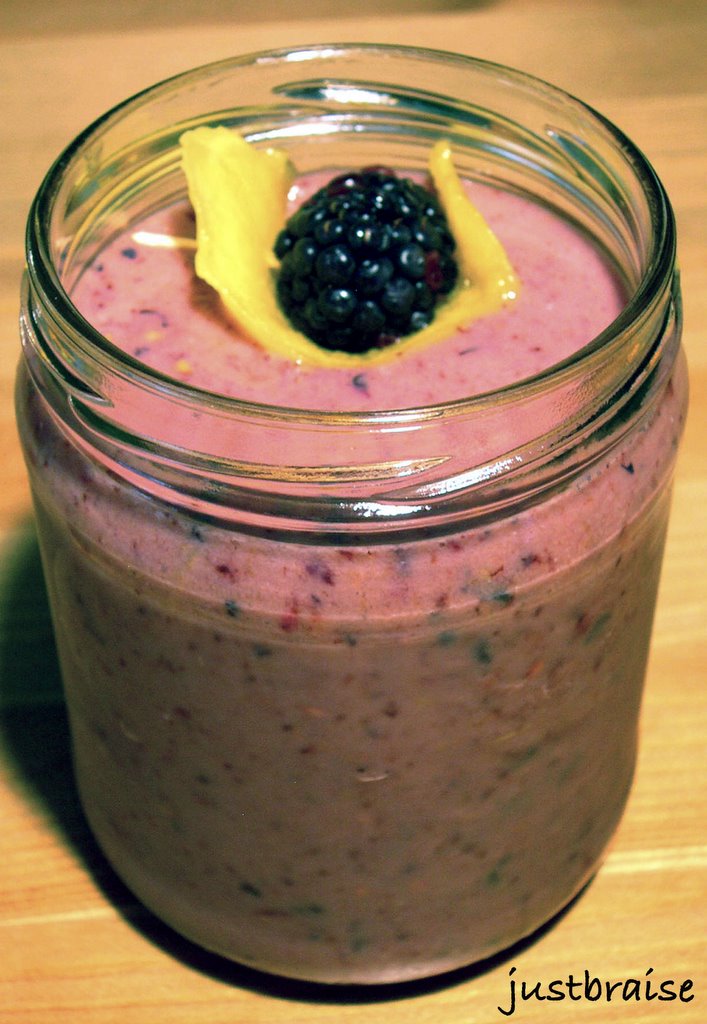
Just when I mention the winter ocean picking up the slack for the things we crave, I desire the joys of summer. With one mango to my name and a handful of blackberries, what else is there, but a delicious smoothie?

I am not talking about that slick electronic “BlackBerry,” I happily do not own and is the joy (and misery) of lawyers across the nation. The blackberry I speak of is plucked from the bush. They turn your clean hands a royal purple and are a sweet and pleasant fruit.

Native to many parts of the world, the blackberries we consume today have been used for over 2,000 years in medicinal and culinary purposes. Their thorny branches are also a tasty way to keep intruders away, though your delicious bush may be plucked clean, the thief will easily be caught purple-handed. The berry was once crushed and used as ink (forget the dog, I might eat my own homework). Today, amidst other disease research, blackberry tannins are being studied for their role in fighting cancer.

While in Latvia, my cousins mixed blackberry juice (as well as current juice, orange juice and vodka—or combination of all) with Balsam—their claim to a quick fix of whatever ails a person: from upset stomach; to hangover; to liver damage. I will say this combination was rather revolting, but alone, blackberry juice was thick and delicious. I have yet to find it in the United States, but maybe my search has not reached far enough.

Though I would not add balsam to this smoothie, a little banana never hurt the texture or flavor…

MANGO TANGO SMOOTHIE
Makes 2 smoothies. Prep time= 8 minutes. Use a hand-held or stationary blender.
* 15-20 blackberries
* 1 ripe mango (for peeling suggestions go here)
* 1 ripe banana
* ¼ cup plain yogurt (vanilla, low-fat, no-fat, regular or soy options work too)
* ½ cup orange juice

1) Place all ingredients in blender. Blend and serve.


Other smoothie options:
Berry Merry Smoothie
Apricot-Mango Smoothie
Berry-Banana Smoothie

Broiled Scallops w/ Horseradish Mashed Potatoes Crowned by Caramelized Onions


It seems that when the weather turns to the worst and our taste buds crave the joys of summer (namely fresh seasonal fruits), the ocean picks up some slack. Like mussels, the plump prizes known as scallops are in season October through March and should definitely be dined on. The jewel of the ocean: soft, sweet, and meaty-- these little bivalves are a kind pick.

Because of their sweet nature, scallops are an ideal pairing with uncommonly used entrée flavorings: sautéed with pear and honey; on a bed of creamy braised leeks; mango salsa; or in this case, accompanied with horseradish mashed potatoes crowned by caramelized onions.

High in flavor, protein, fatty acids, vitamin B12, magnesium, potassium, and low in calories, scallops are the perfect “good for your heart” meal. They are surprisingly filling so do not shy away from the cost that quality scallops can run. In my local fish market I can find the treasured bay scallop for $14 per pound-- I have seen them for as much as $35 per pound.

From the French escalope, written records show that scallops have been harvested in the bays of North America since the late-1700’s (probably even before this time). The scallop shell is the typical “seashell” image many of us carry in our mind—not the conch, mussel, or oyster, it is the circular wave-like shell with a flat base where the two halves connect. A scallop’s age can be gauged by counting the consecutive ridges on the shell. They are hermaphrodites, changing sexes depending on the water’s temperature (talk about a gaggle of girls).

When purchasing scallops, look at them first. Colors should range from off-white, slightly beige, to a pinkish hue. Sizes and shapes should vary slightly. If you see scallops are uniform in size they may be imitation (possibly shark) or cut from larger, less tender scallops. Pure white in color may be a sign that the scallops have been sitting out, absorbing water and chemicals. Next, smell them. They should not have an overly fishy aroma, but a slightly sweet scent. Like all fish, scallops must be kept cold. Immediately after purchasing, put the scallops in the refrigerator. Scallops can be kept fresh for up to two days. However you choose to eventually prepare your scallops, cooking time should be limited to a few minutes. Never overcook your scallops or they will turn into rubber. And in my belief, stay away from fried scallops as it breaks down the delicate quality that makes them so succulent to indulge.

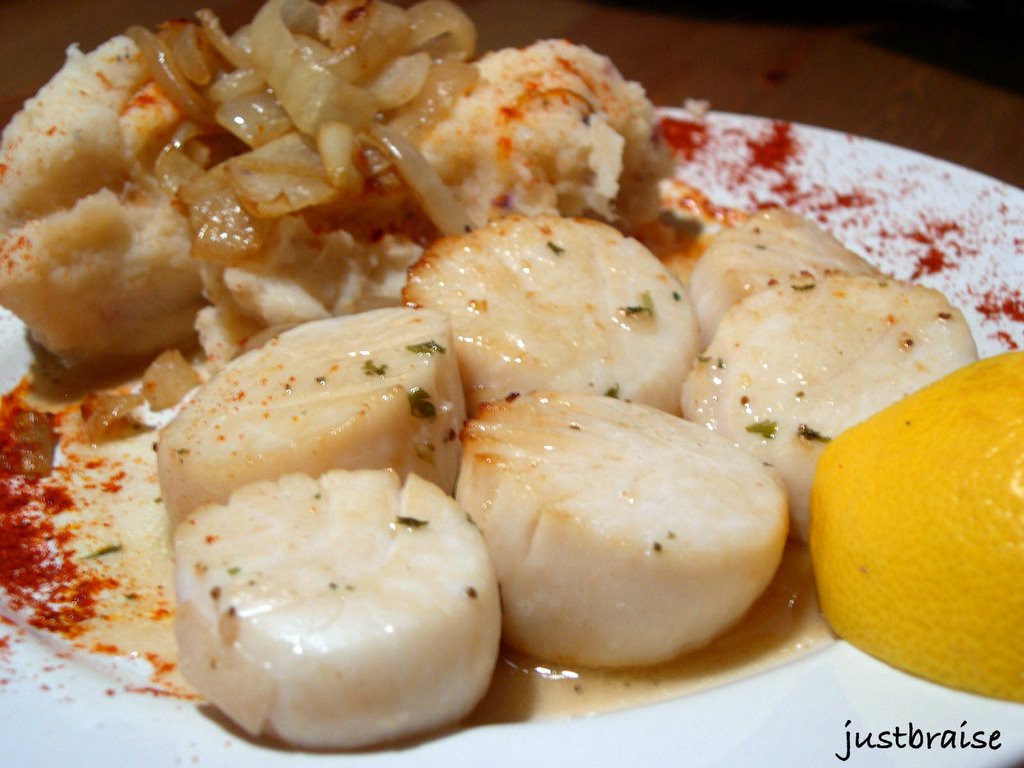
This meal was a simple one. I chose to broil these scallops with a little butter, lemon juice and garlic. The end result was a sweet decadent treat. I was in the mood for horseradish (what is better to accompany fish?) and decided to throw them into buttery mashed potatoes. Topped by caramelized onions, this was a sweet and tangy pairing very fitting to the meal.

BROILED SCALLOPS w/ HORSERADISH MASHED POTATOES & A CROWN OF CARAMELIZED ONIONS
THE SCALLOPS
Makes 2 servings. Prep + Cook Time= 15 minutes.
* 1 lb fresh bay scallops
* 3 Tbl butter, sliced into small chunks
* 1 clove garlic, crushed
* juice of 1 lemon
* 1 tsp celery seed

1) Turn the broiler on. Wash the scallops and place on an oven-safe, non-reactive surface. Do not stack scallops. Add all ingredients evenly distributed over the scallops.
2) Broil 5 minutes, flip, broil 5 minutes (or until each side is slightly golden).


THE HORSERADISH POTATOES
Makes 2 servings. Prep time= 10 minutes. Cook time= 30 minutes
* 2 large red potatoes, peeled half-way and cut into quarters
* 4 Tbl butter
* ½ cup milk (or buttermilk)
* 2 Tbl fresh horseradish
* salt/ pepper to taste
* 1 large yellow onion, sliced

1) In a pot on the stovetop, place potatoes in cold water with a sprinkle of salt. Cover and bring to a boil on medium-high heat. Boil potatoes until soft when poked with a fork.
2) While potatoes are boiling, warm 2 Tbl butter on a skillet. Add onions. Sauté on medium-low heat until onions are golden, about 20 minutes. Stir frequently so onions do not burn.
3) When soft (about 30 minutes), drain water and return to potatoes in the pot to the stove (now place the scallops in the broiler). Add the remaining ingredients and mash until desired consistency (smooth or chunky) is reached. Cover and keep in warm pot until scallops are ready.

Epicurean Love

Thank you to all for the birthday well wishes. Culinary birthday gifts received in no particular order (all are provided much love):

* Dinner with friends
* Le Creuset's new Oval Skillet. It is large and fabulous.
* A large hunky chunk of semi-sweet chocolate
* Silicone oven mit (I pulled vegetables out of boiling water the other day with this thing on!)
* Manicardi Balsamic Vinegar, aged 21 years
* 2 beautiful Riedel stemless Cabernet/ Merlot wine glasses
* Gift certificate to a kitchen store
* Trio of Pure Vanilla Extracts from Nielsen-Massey
* Cuisinart knife set
* Lot's Wyfe salt


View Stats
Rankingblogs.com: Defining your blogs worth..